Who Does Iran Trade With Amid New US Sanctions?
The United States has declared an "economic D-Day," branding its latest financial offensive against Iran as "the single greatest financial offensive ever," aimed at concluding its ongoing conflict with Israel and Iran. However, Tehran, a regime that has faced nearly continuous US sanctions since the Islamic Revolution of 1979, asserts it is "fully prepared" for these new measures. Many economists are skeptical, arguing that Washington's latest move will have a limited impact on the nation.
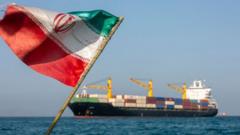
Iran's Key Trading Partners Amid Sanctions
By Decode Today News
Despite decades of economic pressure, Iran has cultivated deep trade relationships with several nations. These partners either possess a history of circumventing US economic strictures or cannot afford to discontinue trade with Tehran without incurring significant economic damage.
China: The Linchpin of Iranian Exports
China stands as Iran's largest trade partner, accounting for a substantial 26.9% of its exports in 2025, according to data from the International Trade Centre (ITC), a joint subsidiary of the United Nations and the World Trade Organisation. This figure, while significant, comes with several caveats. Economists suggest that even prior to the current conflict, a considerable portion of Iranian oil sales, particularly to China, was likely underreported for political reasons, skewing official trade integrity metrics.
The ITC's data collection methodology also presents challenges; it primarily tallies Iran's exports using import numbers reported by its trading partners due to difficulties in obtaining up-to-date export data directly from Iran. Furthermore, import data from some of Iran's partners, such as Iraq, remains incomplete.
Despite these data limitations, China's commitment to its trade relationship with Iran is evident. Beijing strongly opposed the US's "economic D-Day" announcement, labeling it "illegal unilateral sanctions." Chinese officials stated that such economic pressure tactics would not resolve underlying issues and affirmed their intent to safeguard their own economic interests.
Turkey: Navigating Geopolitical and Economic Pressures
Turkey represents another significant trading partner for Iran, as indicated by ITC data. Unlike China, Turkey maintains a considerably friendlier relationship with the United States, placing it in a challenging geopolitical and economic position. The US has explicitly threatened penalties for entities continuing trade with Iran as part of its intensified economic pressure campaign.
However, economists underscore that Turkey faces immense domestic challenges. With official inflation running at a staggering 31.8%, ceasing trade with Iran would inflict significant damage on an already struggling economy. As the sole NATO member sharing a border with Iran, Turkey must balance its strategic relationship with military allies against the imperative of maintaining an essential economic bond with its close neighbor. This delicate balance reflects complex compliance security considerations for Ankara.
Pakistan: A Border, a Mediator, and a Smuggling Challenge
Like Turkey, Pakistan shares a border with Iran and ranks among its largest export partners, according to ITC data. While Pakistan is keen on preserving strong bilateral relations with the US, Washington is, in fact, Pakistan's top export partner. This means Pakistan has substantially more to lose from any economic punishment imposed by the US, influencing its economic operating margin and consumer demand for Iranian goods.
Pakistan also plays a crucial role as a key mediator in peace talks between the US and Iran. Any deterioration in its relationship with either nation could severely complicate efforts to find a diplomatic resolution to the conflict. A further complicating factor is the informal economy along its border with Iran. The BBC has presented evidence indicating widespread oil smuggling from Iran to Pakistan, often carried out by bikers, some as young as 15. This practice predates the current conflict but has reportedly intensified since. Despite pressure from US and Pakistani oil firms, Pakistan's government has struggled to effectively police its remote 900km border. The Iranian government did not respond to previous inquiries from the BBC regarding its alleged involvement in this fuel smuggling.
Armenia: A Russian Ally's Trade Link to Iran
Armenia also emerges as a major trading partner of Iran, according to ITC data. What distinguishes Armenia is its primary export partner: Russia, which accounted for a substantial 34.9% of all goods sold by Armenia in 2025. This strong economic alignment with Russia persists despite Russia having faced extensive sanctions from the US and its allies since its full-scale invasion of Ukraine in 2022. This suggests Armenia's potential willingness to continue its trade with Iran, even in the face of escalating US economic pressure, highlighting a complex network of trade integrity beyond direct US influence.
Understanding the Mechanics of Who does Iran trade
Iran's resilience against US sanctions is not new; it has spent decades developing strategies to circumvent economic blockades. The regime's "fully prepared" stance is built upon a long history of adapting to and mitigating external financial pressures. This includes fostering deep trade ties with nations less inclined or able to comply with US sanctions, and developing informal trade networks that operate beyond conventional enterprise integration and compliance security frameworks.
The challenges faced by the ITC in accurately tracking Iran's trade further underscore the opaque nature of some of these economic activities. Underreported oil sales and incomplete import data from partner countries highlight the difficulty in gauging the true scale and beneficiaries of Iran's trade. This environment incentivizes countries and entities to find alternative ways to conduct business, from direct government-to-government agreements with sympathetic nations to informal, sometimes illicit, cross-border trade like the fuel smuggling seen on the Iran-Pakistan border. These adaptive measures demonstrate how sanctions can sometimes inadvertently foster alternative supply chain resilience for targeted nations.
Expert Skepticism on Sanctions' Efficacy
Despite the US Treasury Secretary Scott Bessent's assertion that the new sanctions will "tighten the noose and block every potential source of revenue," many experts remain unconvinced about their potential impact.
- Oxford Economics, an advisory firm, predicted that the direct impact on Iran's revenues would be "somewhat of a damp squib," suggesting minimal market valuation shifts.
- Ali Vaez, deputy director at the International Crisis Group, noted, "Anything that moves in Iran has already been sanctioned by multiple layers of sanctions, in fact." He argued that the core issue now revolves around enforcement – whether the US possesses the necessary leverage to impose fines and levies on countries that persist in trading with Iran. Vaez pointed to the US's economic dispute with China, Iran's largest trading partner, last year, from which Washington ultimately "backed out."
- Aya Ibrahim, a former senior advisor at the State Department, raised concerns that the US's overreliance on sanctions might inadvertently "incentivize countries to find ways around that system." She also highlighted the ethical dilemma, warning that sanctions often disproportionately affect the general population by denying them "necessities to stay alive," rather than solely impacting government revenues or economic operating margin.
Muted Global Market Response
The announcement of these intensified sanctions received a largely muted response from global markets. Global oil prices experienced a dip following the news but remain considerably higher than their pre-war levels. Stock traders demonstrated even less reaction, with major indexes representing leading companies in the US, Europe, and Asia showing barely any shift. This lack of significant market movement suggests that investors and market analysts share the economists' skepticism regarding the immediate and profound impact of the US's latest economic offensive. The market valuation for key global commodities and indices largely remained stable, indicating a perceived limited threat to broader economic stability or consumer demand.
Ultimately, the US faces a considerable challenge in convincing economists, investors, and its trading partners that its latest sanctions threat is to be taken with the utmost seriousness. The deep-rooted trade ties Iran has forged over decades, combined with the complex geopolitical and economic realities of its partners, underscore the intricate landscape of global economic pressure and compliance security.