Fantasy Football Draft Strategy: Mastering Pick 1.07
The 2026 fantasy football season draws near, and with preseason games now offering tangible data, attention shifts to draft strategies. For those holding the coveted 1.07 pick, a critical decision point arises, balancing high-ceiling talent with consistent production. This position offers unique strategic flexibility, allowing managers to target foundational players while preparing for various draft flows.
Navigating the Top Tier from Pick 1.07
By Decode Today News
While elite prospects like Bijan Robinson, Jahmyr Gibbs, and Ja'Marr Chase are typically off the board by the 1.07 selection, and Puka Nacua is an unlikely reach, a strong tier of talent remains. As the report indicates, this pick often comes down to four compelling players who offer significant upside and a high return on investment.
Amon-Ra St. Brown: The Consistent Target Hog
Amon-Ra St. Brown presents a strong case for a foundational wide receiver at the 1.07 slot. His career trajectory demonstrates remarkable consistency; he has recorded over 119 targets in every one of his five NFL seasons and achieved double-digit touchdowns in each of the last three. This sustained high volume positions him as a reliable anchor for any fantasy roster.
Despite potential ceiling limitations if teammates like Jameson Williams and Sam LaPorta ascend, the Lions' offensive strategy, particularly their stated intention to heavily utilize play-action passes, bodes well for St. Brown. As the report notes, he consistently leads the team in first-read target share on such plays, indicating a high level of trust and strategic importance within the offense. His performance metrics further solidify his appeal, having been a top-three receiver in points per game in recent seasons and never falling outside the top five in total points during that period. Many perceive him as a high-floor option, yet the underlying data suggests he is consistently on the cusp of an overall WR1 finish, offering exceptional investment yield.
Jaxon Smith-Njigba: Emerging with Elite Production
Jaxon Smith-Njigba enters the 2026 season following a truly breakout year, leading the league in receiving yards with 1,793 and securing 10 touchdowns. His massive target volume of 163 (119 receptions) was instrumental in helping the Seahawks reach the Super Bowl, showcasing his immense potential and high consumer demand in their offensive scheme.
A primary concern, as highlighted by the report, is the departure of offensive coordinator Klint Kubiak to become head coach of the Las Vegas Raiders, which could impact quarterback Sam Darnold's efficiency. However, Seattle's decision not to make significant receiver additions, beyond re-signing Rashid Shaheed, suggests Smith-Njigba's role remains central. Furthermore, with Kenneth Walker III departing and Zach Charbonnet recovering from an ACL injury, coupled with the potential slow adaptation of rookie Jadarian Price, there's a possibility of even greater volume for Smith-Njigba. This scenario could enhance his already high market valuation, making him an appealing, albeit slightly riskier, pick compared to St. Brown.
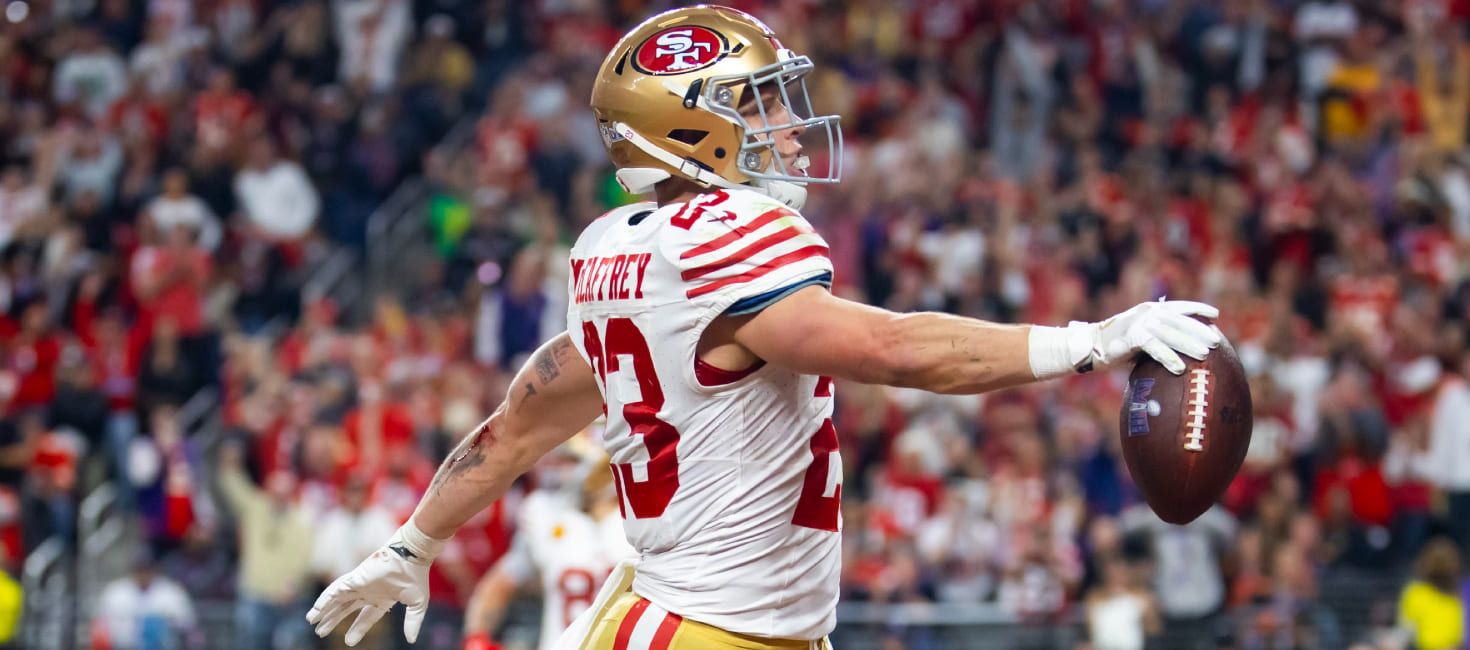
Christian McCaffrey: Elite Production Despite Age Concerns
For those prioritizing the running back position, Christian McCaffrey remains a compelling choice, even after what the report describes as a "very poor season by his lofty standards." His rushing efficiency dipped, recording 3.9 yards per carry (his lowest since 2020) and ranking 48th among running backs with 50+ rush attempts in that metric. He also ranked 47th in yards after contact per attempt and 29th in missed tackles forced.
Crucially for fantasy purposes, these rushing metrics were overshadowed by his exceptional involvement in the passing game. McCaffrey saw an astounding 129 targets, surpassing prominent wide receivers like A.J. Brown, Courtland Sutton, Keenan Allen, and Zay Flowers. This dual-threat capability propelled him to be the RB1 in points per game, scoring 2.5 points more than the RB2. Despite recently turning 30, McCaffrey's unique role and consistent high scoring represent one of the biggest upside swings in fantasy football, offering a significant competitive advantage regardless of his ground game's efficiency. His overall operating margin in fantasy production remains unparalleled.
Jonathan Taylor: A Motivated Contract Year Back
Jonathan Taylor presents another high-upside running back option. He displayed dominant form in the first half of the previous season, and the report suggests that an uninjured Daniel Jones could have sustained that effectiveness. Data from teams synced with FantasyPros tools indicated Taylor led all players in playoff advance rate at 66.8%, implying a two-in-three chance of making the playoffs simply by drafting him.
However, his performance waned post-Week 12, dropping to RB21 in points per game, with a low explosive run rate of 0.7% (41st), ranking 36th in yards after contact, and scoring only three rushing touchdowns. Despite this dip, Taylor's upcoming contract year, likely his last massive one after turning 27 this offseason, provides significant motivation. With his quarterback returning and potentially needing to lean more on the run game, combined with virtually no competition for touches, the report identifies a "very real world where Taylor is a top-two back this season," offering a high potential investment yield.
Players to Approach with Caution
While the 1.07 pick offers substantial talent, certain high-profile players may carry more risk or be overvalued at their current Average Draft Position (ADP), as noted by the writer.
Justin Jefferson: Navigating Quarterback Uncertainty
Justin Jefferson, typically a premier receiver, saw a dip in his 2025 production, recording fewer receiving yards (1,048) than in 2023 when he played only 10 games (1,074). He also posted career-lows in yards per reception (12.5) and receiving touchdowns (two).
The primary concern, according to the report, stems from the Vikings' quarterback situation. While Kevin O'Connell's offensive scheme previously supported quarterbacks like Josh Dobbs and Sam Darnold, the struggled performance of J.J. McCarthy, leading to the removal of middle-of-the-field passes from the playbook, creates uncertainty. The ongoing camp battle between McCarthy and Kyler Murray, with neither player establishing a clear lead, suggests a potential "annoying back-and-forth" that could negatively impact the team's passing game and, consequently, Jefferson's target quality and overall fantasy production. His catchable target rate of 71% (58th among receivers with 50+ targets) in 2025 further highlights this issue. While a bounce-back is possible, his current ADP may not adequately account for this elevated cybersecurity risk in quarterback play.
James Cook: Sustaining Elite Performance
James Cook delivered exceptional performances in both 2024 and 2025, rushing for 1,009 yards and 16 touchdowns in 2024, followed by 1,621 rushing yards and 12 touchdowns in 2025. This sustained production naturally builds confidence in his ability.
However, a counterpoint emerges from quarterback Josh Allen's recent performance, as detailed in the report. Allen recorded his lowest passing-yardage total since 2019 (3,668) and has not thrown for more than 30 touchdowns in the last three seasons. While the Bills anticipate an offensive step forward with the addition of DJ Moore and new head coach Joe Brady, it remains to be seen if this materializes. If the team indeed increases its passing touchdown production and improves ball movement, it could potentially come at the expense of Cook's rushing volume and touchdown upside, capping his potential ceiling. Fantasy managers must weigh his past stellar output against these potential shifts in offensive dynamics and their impact on his overall market valuation.
Strategic Flexibility from the Middle of the Draft Board
Drafting from the middle of the board, specifically at the 1.07 position, offers the most flexibility, allowing managers to initiate their roster construction with either a top-tier wide receiver or a high-upside running back. The landscape for running backs is projected to dry up quicker this year, making initial choices particularly impactful.
Understanding Fantasy Football Draft Mechanics
The strategic choice at 1.07 fundamentally impacts subsequent rounds, influencing the overall balance and resilience of a fantasy roster. A core concept in fantasy football is optimizing for both immediate production and future depth, essentially managing portfolio risk and identifying high-investment yield assets. The decision to prioritize a wide receiver or running back first sets the tone for the entire draft and requires an understanding of positional scarcity and talent tiers. The goal is to achieve a balanced team, minimizing reliance on a single position while maximizing overall scoring potential.
Consider the following strategic pathways:
- WR/WR Start: Committing to two elite wide receivers in the early rounds. This strategy allows managers to embrace a "Zero RB" approach, where running backs are targeted later. This can be paired effectively with an elite tight end like Brock Bowers or Trey McBride in the second or third round. Subsequent running back selections could then target players such as De’Von Achane, Jeremiyah Love, or Breece Hall. This approach leans into the high longevity and consistent target share often found in top-tier wide receivers, creating a stable core with significant investment yield.
- RB First: Opting for an elite running back at 1.07. If a manager tilts towards a running back in the first round, the subsequent wide receiver selection will likely be made from a pool including talent like Drake London, Nico Collins, or A.J. Brown. While running backs tend to be scarce, as the report indicates, neglecting the wide receiver position too heavily in the early rounds (e.g., only one through three rounds) can leave a roster struggling to catch up in terms of consistent receiving production.
The report suggests this year is particularly ripe for a more balanced approach, highlighting the dynamic interplay between positional scarcity and player availability. Utilizing tools like free mock draft simulators can help managers prepare specifically for their league settings and refine their strategy from the 1.07 position, optimizing for future operating margin and competitive advantage.


