Ukraine Launches Major Drone Attack on St Petersburg Oil Terminal, Targets Key Russian Infrastructure
Ukraine Launches Major Drone Attack on St Petersburg Oil Terminal, Targets Key Russian Infrastructure
By Decode Today News
Ukraine has confirmed a significant drone attack on a major oil terminal in Russia's St Petersburg, marking one of the deepest strikes into Russian territory since the full-scale invasion began. The overnight operation targeted what President Volodymyr Zelensky described as "key infrastructure that generates revenue for Russia's war," further escalating Kyiv's campaign against Moscow's energy sector.
Deep Strike Hits Russian Energy and Naval Assets
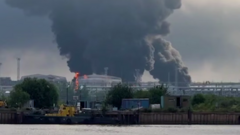
Ukrainian forces conducted a substantial drone assault on critical infrastructure in Russia's Leningrad region, striking a major oil terminal in St Petersburg. President Volodymyr Zelensky explicitly linked the attack to disrupting Russia's war funding. In addition to the oil terminal, Ukraine also claimed to have targeted a key naval base of the Russian Baltic Fleet in Kronstadt, although Moscow has not publicly acknowledged this particular claim. St Petersburg Governor Aleksandr Beglov confirmed the oil terminal strike, reporting no casualties but noting a "massive" drone attack over the city and wider region.
The strike on the St Petersburg oil terminal, which the Ukrainian military described as "one of the largest" in Russia with a capacity of 12.5 million tonnes of petroleum products per year, represents a notable reach for Ukraine's long-range drone capabilities. President Zelensky stated the targets were approximately 850km (528 miles) from Ukraine's border, underscoring the expanding range of Kyiv's offensive operations. A video shared by the Ukrainian president appeared to show a drone approaching a target, followed by a large plume of black smoke billowing from the area after the strike, an event later verified by independent reports.
This incident is the latest in an intensified series of long-range drone attacks by Ukraine on Russia's critical energy infrastructure. Kyiv asserts that these operations have significantly impacted Russia's fuel production, claiming nearly 43% of the country's oil refining capacity has been "disabled." While this specific figure has not been independently verified, Russian President Vladimir Putin recently made a rare admission of fuel shortages stemming from Ukrainian attacks. In response, Putin signed legislation aimed at boosting domestic fuel supplies, highlighting the tangible impact of these strikes on Russia's internal market.
Ukraine defends its targeting of Russian oil and gas facilities, arguing they are legitimate military objectives given Moscow's heavy reliance on fossil fuel exports to finance its ongoing war effort following the full-scale invasion in February 2022. The attacks are part of a broader strategy to degrade Russia's military-industrial complex and economic stability.
Russian Response and Competing Narratives
Governor Beglov reported that 72 Ukrainian drones were successfully shot down over St Petersburg and the broader Leningrad region. He urged city residents to remain indoors until the threat subsided and warned of potential disruptions to mobile internet services. St Petersburg is home to over five million people, making such large-scale drone incursions a significant security concern for Russian authorities.
In its latest operational bulletin, the Russian defence ministry claimed to have shot down more than 500 Ukrainian drones and missiles overnight and during the morning. The ministry characterized the Ukrainian attacks as a deliberate attempt by President Zelensky to "distract the attention" of Ukrainians and "foreign sponsors" from the aftermath of a major Russian strike on Kyiv on July 2, as well as a claimed "catastrophic failure" of Ukrainian forces in the eastern town of Kostyantynivka. Russia reiterated that Ukrainian attacks on its civilian facilities "will not go unanswered," signaling potential retaliation.
The conflict continues to be waged on multiple fronts, including a significant "war of words" between Moscow and Kyiv. On Saturday, President Putin claimed that Russian control had been established over Kostyantynivka in June, a town located within Ukraine's heavily fortified "fortress belt" in the Donetsk region. However, Ukraine's military spokesman, Maj Andriy Kovalyov, denied this claim, stating that "Kostyantynivka remains under the control of the Defence Forces of Ukraine." He admitted to "cases of infiltration by small infantry groups" but affirmed they were being neutralized.
President Zelensky directly challenged Putin's assertion on Telegram, writing: "If Kostyantynivka is now under Russian control, then Putin will probably have no problem meeting me there and finding diplomatic solutions to finally end the war. But still, he will not cross the front line: the truth is very different from Putin's words." This exchange highlights the deep divergence in narratives and the ongoing struggle for control and perception, both on the battlefield and in the international arena.
Global Implications and Diplomatic Maneuvering
The intensification of these long-range strikes and the ensuing war of words are unfolding just ahead of next week's crucial NATO summit in Turkey. Both sides appear eager to project strength and gain the upper hand ahead of this significant diplomatic gathering, where the future direction of support for Ukraine and strategies for addressing Russian aggression will likely be central topics. The attacks underscore Ukraine's determination to take the fight directly to Russian territory, impacting not only military infrastructure but also the broader Russian economy.
Adding another layer to the complex geopolitical landscape, President Putin sent a congratulatory note to former US President Donald Trump on Saturday, marking US Fourth of July celebrations and calling for "constructive relations" between their countries. This diplomatic gesture, amidst escalating conflict and ahead of key international meetings, signals Russia's continued efforts to influence global dynamics.
The strategic importance of St Petersburg, as Russia's second-largest city and a vital economic and naval hub, makes this drone attack particularly significant. It demonstrates Ukraine's growing capacity to project power far beyond the front lines, creating domestic pressure within Russia and highlighting the vulnerability of its critical infrastructure. Such attacks aim to diminish Russia's ability to sustain its war machine and exert pressure on Moscow's leadership.
Frequently Asked Questions
What was targeted in St Petersburg?
The primary target confirmed by Ukraine and Russian authorities was a major oil terminal in St Petersburg. Ukraine also claimed to have hit a Russian naval base in Kronstadt, although Russia has not publicly commented on this.
How far is St Petersburg from Ukraine?
President Zelensky stated that the targets hit in the St Petersburg region were approximately 850km (528 miles) from Ukraine's border, indicating a substantial range for the drone operations.
What is Ukraine's goal with these attacks?
Ukraine aims to disrupt Russia's war economy by targeting critical energy infrastructure that generates revenue for Moscow's war effort. These attacks also serve to put domestic pressure on Russia and demonstrate Ukraine's evolving offensive capabilities.
How has Russia reacted?
Russia confirmed the oil terminal strike and reported shooting down dozens of drones over the region. It accused Ukraine of attempting to distract from setbacks on the front lines and warned that attacks on Russian civilian facilities "will not go unanswered."
The Broader Impact of Escalation
The drone strike on St Petersburg's oil terminal represents a new phase in the ongoing conflict, characterized by Ukraine's increasing willingness and capability to conduct operations deep within Russian territory. These actions not only seek to cripple Russia's economic lifeline but also aim to undermine the Kremlin's narrative of stability and control at home. As both sides intensify their military actions and propaganda campaigns ahead of critical international summits, the global implications of this escalating conflict continue to widen. The strategic importance of Russia's energy exports and military infrastructure means that such attacks will likely continue to shape the trajectory of the war and international responses to it.


