Berlin Pride Attack: Suspect Killed, Islamist Ties Probed
Berlin Pride Van Attack Leaves One Dead, Many Injured
By Decode Today News
One woman was killed and at least 29 others injured after a van was driven into a crowd at a Berlin Pride event on Saturday night, an incident officials described as a likely "Islamist terror attack." The suspect, identified as 21-year-old Abdul Ballout, was later shot and killed during a police operation in west Berlin.
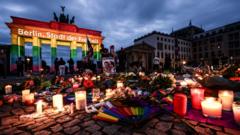
The harrowing incident unfolded at approximately 22:00 local time (20:00 GMT). Police in Berlin received reports that a white vehicle had been deliberately driven into crowds gathered for the annual Christopher Street Day event, which traditionally draws hundreds of thousands of people to Tiergarten park, near the iconic Brandenburg Gate.
Details of the Attack and Immediate Aftermath
The vehicle reportedly struck people on Ahornsteig, a long path weaving through a largely forested section of Tiergarten park. Beyond the vehicle ramming, some individuals also suffered stab wounds, with officials believing a machete may have been used in the attack. The vehicle itself, believed to have been rented, ultimately crashed into a tree, according to police confirmations made a short time after the initial reports.
The atmosphere of celebration quickly turned to chaos and concern. Organizers of the Pride event acted swiftly, abruptly bringing a performance to an end. They took to the stage, advising attendees to begin walking towards the exits. The word "evacuation" was simultaneously projected onto a large screen, reinforcing the urgency of the situation. Unverified videos circulated on social media, depicting large crowds departing the scene as emergency vehicles raced towards the site of the attack.
By approximately 01:00 local time, police officially confirmed the tragic death of one woman and the injury of many others, setting the stage for a city-wide investigation into the terror attack.
The Suspect: Abdul Ballout and His Radicalization
As the investigation commenced, authorities quickly focused on identifying the perpetrator. At about 03:30 on Sunday, police announced on X (formerly Twitter) that they had identified a suspect with Islamist links. The search operation escalated, encompassing the entire city and involving thousands of police officers, including reinforcements from surrounding German states.
The suspect, later named by police as Abdul Ballout, was a 21-year-old German citizen of Lebanese background. He was reportedly known to police and had undergone a process of radicalization, officials stated. Police officers were seen guarding an apartment block in Berlin's Tiergarten district, believed to be Ballout's residence. The extensive search culminated in Spandau, a borough in western Berlin, where Ballout was tracked to an allotment complex.
During a police operation at the complex, Abdul Ballout reportedly rushed at officers with a knife and was subsequently shot and killed, bringing the immediate pursuit to an end.
Abdul Ballout's Troubling Criminal History
The Berlin public prosecutor's office released a statement detailing Ballout's significant criminal history, which underscored his radicalization and propensity for violence:
- In May 2025, prosecutors said Ballout traveled via Turkey to Lebanon with the explicit intention of joining the Islamic State group (IS) in Syria.
- While in Lebanon, he allegedly made contact with several individuals he believed to be members of IS.
- He was arrested in Lebanon in July 2025 and subsequently sentenced to three months in prison for incitement to religious and sectarian conflict.
- Upon his return to Germany in November 2025, he was arrested at Berlin Brandenburg Airport and held in pre-trial detention.
- In May of this year, Ballout was sentenced to one year and 10 months in prison for "preparing a serious act of violence endangering the state." This decision, however, was deferred for six months, and he was placed under the supervision of a parole officer.
- Ballout had prior convictions, including assault and robbery in 2022, and robbing a victim of headphones in 2020.
This history highlights a pattern of radicalization and violent crime, posing significant challenges for national security and compliance security agencies tasked with monitoring such individuals.
Global Outcry and Condemnation of the Attack
The attack triggered a wave of condemnation from leaders across Europe and beyond, emphasizing solidarity with Germany and the values targeted by the terror act. German Chancellor Friedrich Merz condemned the incident as a "heinous" attack, reflecting the profound shock felt nationally.
European Commission President Ursula von der Leyen expressed her deep sympathy for the victims. She underscored that the Pride event represents fundamental European values: "freedom, dignity, and equality." On social media, she affirmed, "Every person should be able to live, love, and stand up for their rights without fear," a powerful statement reinforcing the principles challenged by the attack.
Other European leaders also voiced their support:
- Rob Jetten, Prime Minister of the Netherlands, declared that the Dutch stand "shoulder to shoulder with our German neighbours."
- Italy's Prime Minister, Georgia Meloni, conveyed her "solidarity and sincere sympathy."
- The UK's Defence Secretary, Wes Streeting, described the incident as "an absolutely horrific disaster," extending his thoughts and prayers to the German people.
Understanding the Dynamics of Counter-Terrorism and Crisis Response
The Berlin Pride attack, and the subsequent swift police response, illuminate the complex dynamics inherent in modern counter-terrorism efforts and crisis management. The timeline of events, from the initial reports to the identification and neutralization of the suspect, showcases the immediate operational capabilities required to address such threats. The extensive search operation, involving thousands of officers and coordination across German states, exemplifies the scale of resources deployed to ensure public safety and mitigate further cybersecurity risk or threats to the populace.
The revelation of Abdul Ballout's detailed criminal history, particularly his conviction for "preparing a serious act of violence endangering the state" and his subsequent parole, raises critical questions regarding the monitoring of radicalized individuals within the justice system. Balancing individual liberties with national security imperatives represents an ongoing challenge for authorities. The fact that Ballout, despite his known Islamist links and violent past, was under parole supervision underscores the inherent difficulties in predicting and preventing such isolated yet devastating acts. This incident highlights the continuous need for robust intelligence gathering, inter-agency information sharing, and stringent compliance security protocols to manage and mitigate threats posed by radicalized individuals. The rapid global condemnation also reflects a unified international resolve against acts that seek to undermine core democratic values and human rights.
Key Timeline of Events
- Saturday, 22:00 local time (20:00 GMT): A white van is driven into crowds at the Berlin Pride event in Tiergarten park. Reports of stabbings with a suspected machete.
- Immediately After: Pride event cancelled; organizers advise evacuation; "evacuation" projected on screen.
- Saturday, ~01:00 local time: Police confirm one woman killed and many injured; vehicle found crashed into a tree.
- Sunday, ~03:30 local time: Police announce identification of a suspect with Islamist links, widening the search across Berlin.
- Sunday (Later in the day): Abdul Ballout, 21, identified as the suspect, a German citizen of Lebanese background, known to police and radicalized.
- Sunday (Later in the day): Police operation in Spandau results in Ballout being shot and killed after rushing officers with a knife.
- Post-Attack: German Chancellor Friedrich Merz and other European leaders condemn the attack, emphasizing values of freedom, dignity, and equality.


