Decode Today News delivers breaking news on AI, tech, business, politics, and world events — updated daily.
breaking news, AI news, technology news, India news, world news, business news #decodetodaynews
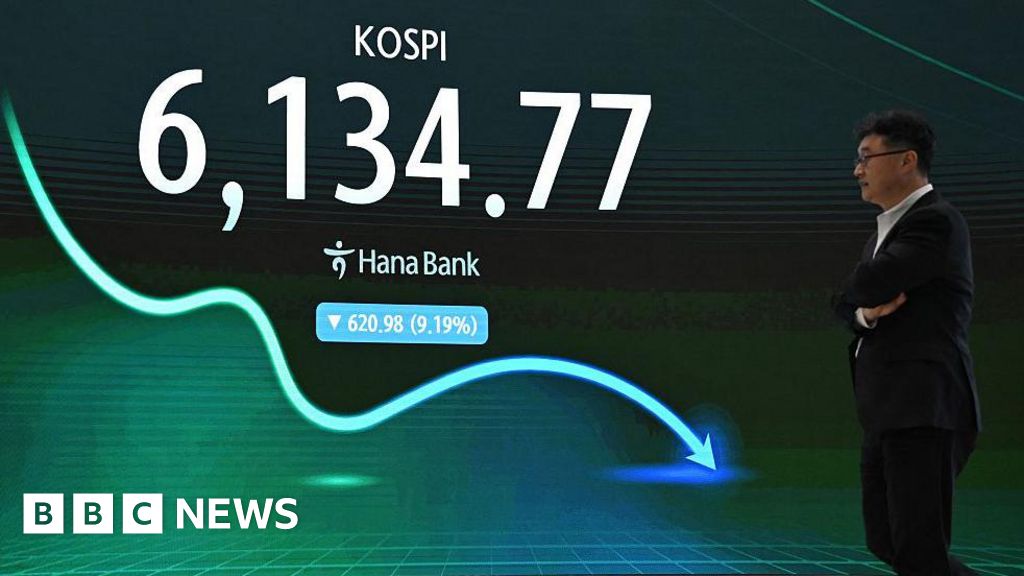
Chip stocks globally, particularly in Asia and the US, experienced significant declines on Tuesday, with South Korea's benchmark Kospi index pausing trading after an 8% slide, fueled by investor jitters surrounding **AI** spending and market concentration. The market movements followed a 5% fall for **AI chip giant Nvidia** in New York on Monday, which saw it lose its position as the world's most valuable listed company to **Apple**.
Trading on the Kospi index was temporarily halted on Tuesday morning after the initial sharp decline. The circuit breaker mechanism, designed to calm panic selling, was lifted after 20 minutes, but the index continued its slide, ultimately closing 10.8% lower. This slump was predominantly led by technology firms, with major players Samsung Electronics and SK Hynix both experiencing falls of more than 13%. South Korea's stock market has seen heightened volatility this year, partly due to a surge in retail investor participation, often using debt to buy stocks, which, as Jane Sydenham, investment director at Rathbones, noted, "exaggerates the movements when we get a correction like this." The Kospi had more than doubled from the start of the year to mid-June but has since shed approximately a third of its value.
In the US, **SK Hynix's** US-listed shares saw a 7.5% drop on Monday, trading significantly below their $149 (£112.11) offer price from a record-breaking Nasdaq debut on July 9. Japan's Nikkei 225, another index heavily weighted with tech companies, closed nearly 4% lower, reflecting broader Asian market sentiment.
Sydenham attributed the Asian market slump to a correction after "phenomenal rises" over the preceding months, highlighting the Korean market's high concentration of investment in companies like Samsung and SK Hynix. She further explained that the sell-off was triggered by **Nvidia's** shares falling on Monday. This decline came after a report by the Wall Street Journal indicated that **Nvidia** was in discussions to potentially provide around $250 billion for **OpenAI** as part of a substantial data-center project. The BBC has reportedly contacted **Nvidia** and **OpenAI** for comment regarding this development.
Nvidia and Apple Battle for Top Valuation
By Decode Today News
Chip stocks slide in US and Asia as AI jitters rattle investors Decode Today
The downturn in **Nvidia's** stock allowed tech titan **Apple** to reclaim its mantle as the world's most valuable company. The iPhone maker's shares have risen by about 25% this year, showcasing robust consumer demand for its diversified product and services ecosystem. Cheng Chye Hsern, head of investments at wealth manager Providend, pointed out that **Apple** stands as one of the few prominent technology firms "not taking part in the **AI** race" in the same capital-intensive way as its rivals. This positioning, he suggested, makes the stock particularly appealing to investors who harbor concerns about the enormous capital expenditure, specifically billions being allocated to **AI infrastructure** like data centers, by other tech giants.
Understanding the Underlying Mechanics of AI Investment
Investor apprehension about **AI** spending among technology firms has been a recurring theme over the past couple of months, consistently "testing investors' nerves," as Sydenham observed. A primary concern revolves around the potential for these colossal investments to yield a "proper return in the future," a critical factor for assessing **investment yield** and **operating margin** in high-growth, high-capex sectors. The immense capital outlay required for **AI infrastructure**, including advanced data centers and specialized **AI chips**, raises questions about the long-term profitability and sustainability of current market valuations. This dynamic is crucial for **enterprise integration** strategies involving **AI** and the overall financial health of companies deeply committed to this technological frontier.
Jun Bei Liu, founder of investment firm Ten Cap, also informed the BBC about rising anxieties concerning increasing competition, particularly from China, in the **AI chip** sector. She noted that some investors are consequently "taking some profit off the table," but she anticipates that they are likely to reinvest in these stocks following the US holiday season. Companies like CXMT, which manufactures dynamic random-access memory (**DRAM**) chips essential for powering **AI** data centers, mobile phones, PCs, tablets, and other devices, are key players in this competitive landscape. **CXMT** has stated plans to allocate most of its initial public offering (**IPO**) proceeds towards boosting production capabilities and enhancing research and development efforts, underscoring the ongoing push for innovation and market share.
European Markets Show Divergent Trends
In contrast to the Asian and US markets, major European stock markets largely shrugged off the **AI** spending concerns when they opened on Tuesday. The UK's FTSE 100 index, France's Cac 40, and the German Dax 40 all showed resilience. These indices typically have relatively less exposure to companies at the forefront of the **AI chip** and data center build-out. A couple of hours into trading, all three European benchmarks were approximately 0.6% up, indicating a more stable, albeit disconnected, market sentiment from the tech-heavy declines seen elsewhere.
Key Market Insights Amid AI Volatility
South Korean Kospi: Experienced a temporary circuit breaker halt, ultimately closing 10.8% down, driven by technology firms like Samsung Electronics and SK Hynix.
Nvidia's Valuation Shift: A 5% drop for **AI chip giant Nvidia** on Monday led to **Apple** reclaiming its position as the world's most valuable listed company.
Investment Concerns: Experts like Rathbones' Jane Sydenham highlight investor worry over the massive **AI infrastructure** spending and whether it will deliver a "proper return" for the substantial **investment yield**.
Market Concentration: The Korean market's high concentration in a few tech stocks, combined with retail investors buying with debt, exacerbated market movements.
US and Japan: US-listed SK Hynix shares fell 7.5%, while Japan's Nikkei 225 closed nearly 4% lower, reflecting a regional tech downturn.
European Resilience: The UK's FTSE 100, France's Cac 40, and Germany's Dax 40 showed slight gains, demonstrating less exposure to direct **AI** sector volatility.
Competitive Pressures: Concerns about increasing competition from China are influencing investor behavior, with some "taking profit off the table."
Decode Today News delivers breaking news on AI, tech, business, politics, and world events — updated daily.
breaking news, AI news, technology news, India news, world news, business news #decodetodaynews