Decode Today News delivers breaking news on AI, tech, business, politics, and world events — updated daily.
breaking news, AI news, technology news, India news, world news, business news #decodetodaynews
Ads
Breaking News
Home/AI/Decode Today/Technology/Meta Unveils Invisible AI Watermark and Detection Tool for Its Generated Images and Video
Meta Unveils Invisible AI Watermark and Detection Tool for Its Generated Images and Video
Meta Unveils Invisible AI Watermark and Detection Tool for Its Generated Images and Video
By Decode Today News
Meta built an AI detection tool to ID images and video created with its new models Technology
Meta is rolling out a new layer of authenticity for its burgeoning artificial intelligence ecosystem, introducing an innovative, invisible watermarking system called Content Seal, along with a dedicated web-based detection tool. This significant move aims to help users identify images and videos created or edited using Meta's new generative AI models, starting with its Muse Image generator. The initiative addresses growing concerns about AI-generated content and the need for clear attribution, a challenge that has become central to digital trust.
Meta's Content Seal and Detection Tool: What You Need to Know
Meta has launched Content Seal, an invisible watermarking technology embedded into images and, soon, videos created with its AI models like Muse Image. This proprietary system is designed to persist even after significant modifications such as cropping, compression, resizing, or screenshotting. A new web-based detection tool allows users to upload an image and check for the presence of a Content Seal watermark, providing an initial method to verify if content originated from Meta AI. While currently limited to specific new models, Meta plans to expand its application, signaling a broader commitment to transparency in AI-generated media.
The development of Content Seal marks a strategic shift for Meta. Unlike some earlier iterations of Meta AI that incorporated visible logos in the corner of generated content, the new system operates discreetly. This invisible watermark is a proprietary technology for its current implementation within Muse Image, although Meta has previously released open-source versions of similar tech. The company states its intent to integrate Content Seal watermarks into AI-generated and edited videos, with a new video generation model, Muse Video, expected to launch soon.
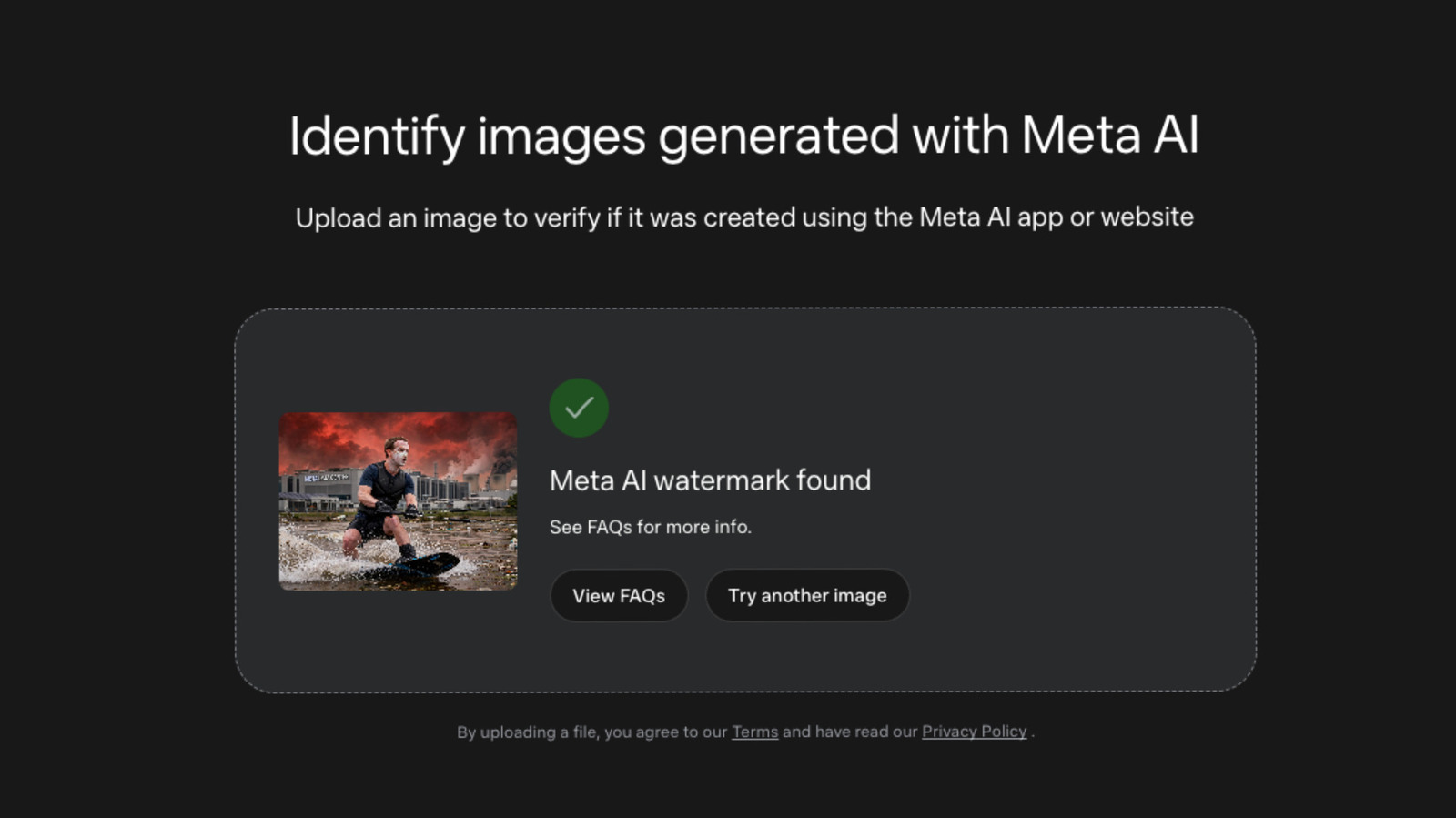
Early testing of the new web-based detection feature demonstrates its immediate utility. Images freshly created or edited using Meta AI, including those entirely generated by the AI, were successfully identified with a Content Seal watermark. Even screenshots of these AI-processed images retained the watermark and were detected by the tool. According to Meta's FAQ, a "positive result" confirms the image was processed via the Meta AI app or meta.ai, while a "negative result" suggests it's unlikely to have originated from these specific Meta platforms.
However, the new detection capabilities are not without their initial limitations. Curiously, the Meta AI app itself does not yet seem to integrate this detection feature. When queried about an AI-generated image that the web tool had positively identified, the app-based assistant reportedly stated it lacked the ability to check, explaining, "Meta AI doesn't automatically watermark images, and I don't have a tool that can detect which AI model made an existing image." This suggests a phased rollout or ongoing development for the in-app experience.
Navigating the Complexities of AI Attribution
Meta's push for better AI content identification comes after facing scrutiny regarding its labeling practices. Earlier this year, the company's Oversight Board expressed concerns about the "inconsistent implementation" of digital watermarks on AI content generated by Meta's own tools. This new initiative appears to be a direct response to such feedback, aiming to establish a more robust and consistent framework for content provenance.
Despite its innovative approach, Content Seal is not designed to be universally compatible with all existing AI watermarking standards. It currently does not integrate with established methods like SynthID or C2PA Content Credentials, which are utilized by other major companies and industry consortiums. This fragmentation across different platforms highlights an ongoing challenge within the broader technology sector to establish unified standards for AI content identification and attribution.
Furthermore, the web-based detection feature currently has some specific operational constraints. During testing, it was unable to identify images created or edited with earlier versions of Meta's AI models. Uploading older AI-generated content did not yield a positive watermark detection. Compounding this, the tool also appears to be subject to Meta's rate limits, with users reportedly encountering a "daily limit on identification checks" after processing a handful of examples. These initial restrictions point to a system still in its early stages of deployment and refinement.
Why AI Detection Matters for Global Readers
In an era where synthetic media is becoming increasingly sophisticated, the ability to discern human-created content from AI-generated or AI-modified content is paramount. For global readers, this technology can significantly impact trust in online information, from news and social media to marketing and entertainment. Clear attribution helps mitigate the spread of misinformation, deepfakes, and other forms of deceptive content that leverage advanced AI capabilities. As AI image and video generation tools become more accessible and powerful, the demand for robust detection and authentication mechanisms will only grow.
This effort by Meta also reflects a broader industry trend toward responsible AI development. Companies are increasingly recognizing their role in fostering transparency and accountability for the tools they release. While invisible watermarks offer a subtle way to embed provenance, their effectiveness will depend on widespread adoption, continuous development to counter evolving AI manipulation techniques, and integration into a broader ecosystem of digital verification tools. For users, the presence of a reliable detection tool offers a concrete step towards better understanding the origin of the digital content they encounter daily.
Frequently Asked Questions About Meta's AI Detection Tool
What is Meta's new AI detection tool called?
The new detection tool is a web-based feature designed to identify images with Meta's "Content Seal" watermark. The watermark itself is a proprietary system, part of Meta's efforts to label content from its AI models like Muse Image.
How does Content Seal work?
Content Seal is an invisible digital watermark embedded into images and planned for videos created with Meta's new AI models. It is designed to be persistent, meaning it remains detectable even if the content is cropped, compressed, resized, or screenshotted.
Can the tool detect all AI-generated images?
No, currently the detection tool is limited to identifying images created or edited with Meta's *new* AI models, specifically Muse Image. It was unable to detect content from older versions of Meta AI or images generated by other companies' AI models (which might use different watermarking standards like SynthID or C2PA).
Is the AI detection tool available in Meta AI apps?
As of its preview, the detection feature is available as a web-based tool. The Meta AI app itself reportedly does not yet have the capability to check for Content Seal watermarks, indicating it's not yet integrated into the in-app assistant.
The Road Ahead for AI Attribution
The introduction of Content Seal and its accompanying detection tool is a significant step by Meta in addressing the complex challenges of AI content attribution. While early limitations exist, such as its exclusivity to newer Meta AI models and the absence of in-app integration, the underlying technology represents a crucial commitment to transparency. As AI models continue to advance, the ability to reliably identify their output will be vital for maintaining trust across digital platforms. This move by Meta sets a precedent, and the industry will likely watch closely to see how Content Seal evolves, its compatibility with broader standards, and its effectiveness in the ongoing effort to ensure authenticity in the rapidly expanding world of AI-generated media.
Decode Today News delivers breaking news on AI, tech, business, politics, and world events — updated daily.
breaking news, AI news, technology news, India news, world news, business news #decodetodaynews