EU Border System Triples Passport Control Times
New EU Border System Sparks Significant Travel Delays Across Europe
By Decode Today News
Europe's recently implemented Entry Exit System (EES) has nearly tripled the time it takes for non-EU citizens, including those from the UK, to clear passport control, according to a senior executive at Rome's main Fiumicino Airport. This development comes despite recent improvements to the system, raising alarms among airlines and travelers about potential disruptions this summer.
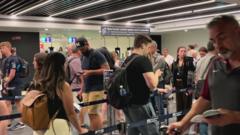
The European Commission (EC) maintains that most EU airports are experiencing limited disruption, affirming its commitment to supporting member states through the system's ongoing implementation. However, airlines such as Ryanair have already issued warnings, advising passengers bound for Europe to prepare for extended waits, labeling the rollout as "failed" in its current state and a source of "unnecessary delays and long queues."
Understanding the Mechanics of Border Technology
The digital Entry Exit System (EES) represents a significant overhaul of border management within the Schengen area, which encompasses 29 European countries. Designed for non-EU citizens, the system mandates the registration of biometric data, specifically fingerprints and a photograph, upon their initial entry into the Schengen zone. This information is subsequently verified upon their departure, forming a comprehensive digital record of their travel movements. The phased introduction of this system began in October.
The core technology underpinning EES primarily involves standalone, automated machines referred to as "kiosks." These units are designed for self-service registration of biometric information. In specific scenarios, such as for children under the age of 12, the process still requires interaction with a border officer. This dual approach aims to balance automation with the necessary human oversight for certain traveler demographics, though it has introduced unforeseen operational complexities.
Airport Officials and Travelers Report Widespread Issues
The rollout of the EES has been met with significant operational challenges at several European travel hubs. Reports from various airports indicate hours-long queues at passport control, leading to considerable frustration and, in some instances, passengers missing their scheduled flights home.
At Rome's Fiumicino Airport, a perpetually popular destination for international tourists, the impact of the EES has been acutely felt. Ivan Bassato, the airport's Chief Aviation Officer, detailed to the BBC that the processing time for UK nationals has surged from an average of seven minutes to 20 minutes, even after significant adjustments. Bassato emphasized that the current quality of the process does not match pre-EES efficiency, stating, "We are not at the point where you have the same quality of the process [as] before the EES." He further expressed the airport's dissatisfaction with one or two-hour waits, calling for urgent fixes to "certain aspects of the system" to enhance operating margin and consumer demand.
Travelers recount their experiences:
- Carl, visiting Rome from Yorkshire with young children, reported a two-hour wait from disembarking the plane to clearing border control. "I knew it was going to be bad, but not as bad as that," he remarked.
- David, from the US, and his wife Marlo, experienced an hour-long queue, resulting in them missing their pre-booked driver.
- Barry, from Bracknell, who landed in Barcelona before a cruise to Rome, spent 45-50 minutes at passport control, attributing the delay to non-functional machines. His companion, Sarah, on a separate flight to Barcelona, endured nearly an hour's wait, describing the queue as "huge" and "just slow."
Technological Bugs and Enterprise Integration Challenges
Beyond the logistical strain, the EES has also encountered technical hurdles. In Portugal, another country reporting significant EES-related holdups, Superintendent Pedro Oliveira, head of border control at Faro Airport, confirmed issues with the new EU IT system. He noted that queues which previously took ten minutes can now stretch to over thirty minutes. While automated machines are generally the quickest processing method, Supt. Oliveira admitted to the presence of "bugs" within the system.
Highlighting the complexities of large-scale enterprise integration, Supt. Oliveira explained, "[EES] makes us very dependent on the technology... servers often are intertwined and connected, so sometimes something that happens in Warsaw affects our system here." He further detailed instances where "complications with the server of the European Union" led to simultaneous system crashes across all member states, requiring several minutes for reboots. While these severe incidents are now occurring less frequently, they underscore the inherent cybersecurity risk and systemic vulnerabilities of such a vast, interconnected digital infrastructure.
Airport Adaptations and Calls for Systemic Reform
Faced with mounting pressure and operational inefficiencies, airports have begun implementing their own adaptations. Rome's Fiumicino Airport, for instance, initially invested approximately €12 million ($13.7 million, £10.2 million) in standalone self-service kiosks. However, these proved impractical for handling large passenger volumes. In response, Fiumicino has now enabled UK nationals to register their fingerprints and photos directly at passport e-gates, a move that Chief Aviation Officer Bassato stated "improved things significantly." Children under 12, however, must still be processed by a border officer.
Faro Airport has also taken steps to mitigate delays, including recruiting additional border officers. In Portugal, children under 16 are directed to border police staff for biometric information recording. These measures, while helpful, appear to be stop-gap solutions to a more fundamental issue of system design and implementation.
Industry stakeholders are actively lobbying for more flexibility within the EES framework. Bassato advocates for the removal of duplication within the process and greater adoption of the EU's pre-registration app, which currently is only utilized by Sweden and Portugal. Furthermore, airports and airlines have been pressuring the EC to permit member states to proactively suspend the EES process ahead of anticipated peak travel periods. However, a recent meeting earlier this month did not result in any changes to this policy, meaning countries can only suspend EES under pre-defined "exceptional circumstances."
Key Insights on the EES Implementation Challenges
The deployment of the Entry Exit System highlights several critical areas for improvement in large-scale technological rollouts affecting international travel:
| Aspect | Challenge/Impact | Source Confirmation |
|---|---|---|
| Processing Time | Tripled for non-EU citizens, e.g., 7 mins to 20 mins for UK nationals at Rome Fiumicino. | Ivan Bassato, Fiumicino Airport |
| Passenger Experience | Hours-long queues, missed flights, significant frustration. Individual waits up to 2 hours reported. | Travelers Carl, David, Barry, Sarah; Ryanair |
| Technology Reliability | "Bugs" in EU IT system, server dependencies, simultaneous system crashes across member states. | Supt. Pedro Oliveira, Faro Airport |
| Cost Efficiency | €12m kiosks at Rome Fiumicino found impractical, leading to investment in e-gate integration. | Ivan Bassato, Fiumicino Airport |
| Operational Flexibility | Countries can only suspend EES under "exceptional circumstances," industry seeks proactive suspension. | Airports/Airlines, EC |
| Interoperability | Dependencies between national and central EU servers create vulnerabilities. | Supt. Pedro Oliveira, Faro Airport |
As the peak summer travel season approaches, the pressure on the EES to deliver seamless border control will only intensify. The experiences reported by travelers and airport officials underscore the need for swift and comprehensive fixes to ensure both security compliance and efficient traveler flow.


