East Asia Braces for Destructive Typhoon as Landslides Kill 15 in Philippines
East Asia Braces for Destructive Typhoon as Landslides Kill 15 in Philippines
By Decode Today News
East Asia is preparing for the imminent arrival of Typhoon Bavi, a colossal storm described as one of the most destructive in decades, even as the southern Philippines reels from its initial impact. Landslides triggered by the intensifying weather have already claimed at least 15 lives on the Philippine island of Mindanao, with rescuers continuing the urgent search for missing individuals amidst ongoing moderate to heavy rains. The typhoon, spanning an immense 1,000 kilometers – roughly the width of France – is sweeping across the Pacific Ocean, setting a perilous course towards Taiwan, a chain of remote Japanese islands, and ultimately, south-eastern China. The widespread threat has prompted mass evacuations, significant travel disruptions, and a scramble by residents across the region to secure essential supplies and protect their homes and livelihoods.Typhoon Bavi: Key Updates and Regional Impact
Typhoon Bavi, an exceptionally large and powerful storm, is currently threatening a vast swathe of East Asia after causing deadly landslides in the southern Philippines. The typhoon is expected to bring extreme rainfall to Taiwan and Japan's Sakishima Islands before making landfall in China's Fujian province. Authorities across the region have initiated extensive preparedness measures, including the deployment of soldiers, distribution of sandbags, and mass cancellations of flights and school classes, as communities brace for what experts predict could be a highly destructive event.The situation in Mindanao remains critical, where families were tragically buried overnight by the rain-fueled landslides. Emergency services are working tirelessly, combing through debris in a desperate search for survivors. Officials have warned that parts of the Philippines will continue to experience significant rainfall throughout the weekend, exacerbating conditions for recovery efforts and potentially triggering further hazards.
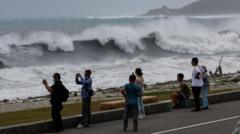
As Bavi progresses, Taiwan finds itself directly in the storm's path. Taiwanese authorities have issued stern warnings, anticipating rainfall totals that could reach up to 1 meter (39 inches) in some areas, particularly the north and east. In a massive preparatory move, the island's defense ministry has mobilized approximately 29,000 soldiers, placing them on standby to assist with potential relief and rescue operations. This level of readiness underscores the gravity of the threat, with Taiwan's Central Weather Administration noting that Bavi is projected to be the largest storm by size to impact the island since 1987, highlighting its historic scale.
Across the region, the impending storm has instilled a sense of urgency. Farmers, keenly aware of the precious window of calm weather, have rushed to harvest their crops or implement protective measures to safeguard their yields. Fishing communities have likewise taken proactive steps, securing their vessels tightly against the anticipated fury of the typhoon. "Don't be fooled by the nice and calm weather now. A storm like this could be the most terrifying," cautioned Chen Ming-hui, a 60-year-old fisherman, in an interview with Reuters, capturing the pervasive apprehension.
In anticipation of severe flooding, thousands of sandbags have been distributed to residents and business owners in low-lying and flood-prone areas. These community-level preparations are vital first lines of defense against the storm's projected heavy rainfall and potential storm surges.
Across the Taiwan Strait, China is also bracing for the typhoon's substantial impact. The nation's meteorological agencies have warned of "significant impact" from Bavi, which is expected to initially smash into the southeastern Fujian province on Saturday. Adding to the complexity, forecasts suggest that Bavi's immense size and "abundant energy" mean its remnants and outer rainbands could track northward, affecting provinces like Jiangsu and Anhui, and potentially reaching the Bohai Sea region. Ma Jun, director of China's Institute of Public and Environmental Affairs, specifically urged northern provinces – which have "less experience" in dealing with typhoons compared to the south – to "strengthen preparations." Some models even suggest the possibility of Bavi making landfall twice in China, presenting a prolonged and multi-faceted challenge.
The memory of a recent devastating storm remains fresh in southern China. Parts of the region are still reeling from the aftermath of Typhoon Maysak, which wreaked havoc earlier this week. Maysak was responsible for the deaths of at least 39 people, with rescuers still searching for missing individuals amid widespread wreckage. Over 130,000 people were evacuated, primarily from the Guangxi region. The typhoon also led to immense agricultural losses and the death of large swathes of livestock. In a rare meteorological phenomenon, Maysak also spurred two tornadoes in the central Hubei province, underscoring the unpredictable and varied destructive potential of such powerful weather systems.
Meanwhile, residents on Japan's remote Sakishima Islands are also on high alert. Local communities are taking extensive precautions, with online photographs showing individuals meticulously taping up windows and draping windproof nets across their homes and shops in an effort to mitigate damage from the anticipated high winds and heavy rains.
The widespread threat of Typhoon Bavi has severely disrupted travel across East Asia. Numerous airlines have grounded flights, causing significant inconvenience and affecting tens of thousands of passengers. Japan Airlines, for instance, has canceled more than 100 flights scheduled for Friday and Saturday, impacting nearly 20,000 travelers. All Nippon Airways, another major Japanese carrier, has canceled over 160 flights through Sunday, affecting approximately 20,000 people. Further demonstrating the regional scale of the disruption, Thai Airways and Malaysia Airlines have also grounded flights to and from Taipei, signaling a broad-based response to the typhoon's hazard.
Why This Matters to Global Readers
The unfolding events surrounding Typhoon Bavi are of significant global concern, extending far beyond the immediate geographical impact. East Asia is a crucial hub for global manufacturing, trade, and technology. Major disruptions to supply chains, infrastructure, and human resources in this region can have ripple effects on international markets and economies. The sheer scale of Bavi, coupled with its potential for widespread destruction across multiple nations, highlights the increasing frequency and intensity of extreme weather events, which are topics of global scientific and environmental discourse.
Moreover, the coordinated emergency responses, from the deployment of military personnel to the public's proactive preparations, offer valuable insights into disaster management strategies. The human stories of resilience, loss, and community action serve as a poignant reminder of the universal challenges posed by natural disasters and the enduring spirit of communities facing adversity. For businesses, the impact on shipping, travel, and local economies underscores the importance of risk assessment and contingency planning in an interconnected world.
Frequently Asked Questions About Typhoon Bavi
What is Typhoon Bavi and where is it headed?
Typhoon Bavi is a massive and powerful tropical storm, measuring approximately 1,000 kilometers (620 miles) at its widest point. It is currently sweeping across the Pacific Ocean towards Taiwan, is expected to affect remote Japanese islands, and is projected to make landfall in southeastern China's Fujian province.
Which countries are most affected by Typhoon Bavi?
The typhoon has already caused deadly landslides in the Philippines. It is expected to bring severe weather to Taiwan, Japan's Sakishima Islands, and a large portion of coastal and potentially interior China, particularly Fujian, Jiangsu, Anhui, and the Bohai Sea region.
What kind of damage and disruption is expected?
Expected impacts include deadly landslides, widespread flooding due to heavy rainfall (up to 1 meter in Taiwan), significant agricultural losses, damage to infrastructure, and extensive travel disruptions including mass flight cancellations. Experts predict Bavi could be one of the most destructive storms in decades.
How does Typhoon Bavi compare to recent storms?
Typhoon Bavi is notable for its immense size and destructive potential. It is expected to be the largest storm by size to hit Taiwan since 1987. Its impact also follows closely on the heels of Typhoon Maysak, which recently caused significant devastation and at least 39 deaths in southern China.
The Regional Challenge Ahead
As Typhoon Bavi continues its relentless advance, the focus remains firmly on regional preparedness and the immediate safety of millions across East Asia. The unfolding situation highlights the complex challenges nations face in mitigating the impact of increasingly powerful weather systems. With critical infrastructure, vital agricultural lands, and densely populated areas in its path, the coming days will test the resilience and resolve of communities from the Philippines to China. The immediate priority is the continuation of rescue efforts in the Philippines and the diligent execution of emergency plans across Taiwan, Japan, and China, as the world watches a region brace for what could be a truly devastating natural event.


