British Steel Taken Into Public Ownership Amid UK Supply Concerns
UK Government Nationalizes British Steel to Protect Key Industrial Capability
By Decode Today News
The British Steel operation in Scunthorpe has been taken into public ownership by the UK government, a strategic maneuver aimed at safeguarding approximately 2,700 jobs in the region and preserving what officials described as a "vital national capability." This decision follows years of financial uncertainty surrounding the steelworks, which also underpins numerous other industries across North Lincolnshire and is critical for maintaining robust supply chain resilience within the UK.
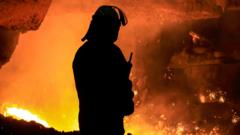
The move to nationalize comes after Parliament on Wednesday passed specific legislation permitting the government to bring key steel industry assets into public ownership under predefined public interest criteria. Previously, while the UK government had overseen British Steel's operations in Scunthorpe for the past year, ownership by China's Jingye Group limited its direct control over long-term strategic decisions. Nationalization now grants the government full authority and flexibility to determine the plant's future trajectory, crucially keeping its blast furnaces operational in the interim.
Financial Implications and Operational Challenges
The financial burden of maintaining British Steel's operations is significant. A report released in March by the National Audit Office (NAO) highlighted that the Scunthorpe steelworks was incurring costs for the government amounting to approximately £1.3 million a day. This substantial expenditure underscores the challenging operating margin faced by the industry, making long-term government proprietorship economically unsustainable without significant restructuring or investment.
Jingye Group, the former owner, is actively seeking compensation for the nationalization, having previously stated that the business was experiencing daily losses of around £700,000. Despite repeated attempts, the BBC was unable to obtain a response from Jingye regarding Thursday's announcement.
Business Secretary Peter Kyle informed the BBC that the government is committed to covering the running costs "for the immediate future." He clarified that an independent assessor would be appointed to evaluate the company's market valuation and determine the appropriate level of compensation for Jingye. Kyle emphasized the stark alternative: "If that business disappears, we will lose the ability for primary steel production in our country, we will become entirely dependent on global supply." This highlights the critical imperative of the nationalization in securing the nation's industrial base and mitigating over-reliance on international markets.
Understanding the Strategic Imperatives Behind British Steel's Nationalization
The decision to nationalize British Steel is rooted in a complex set of strategic imperatives, extending beyond mere job preservation to encompass national security, industrial sovereignty, and long-term economic stability. The UK's ability to produce "virgin" steel directly from iron ore is a critical component of its industrial strategy, ensuring self-sufficiency for essential infrastructure projects and reducing vulnerability to global supply chain disruptions. Should the Scunthorpe plant cease production of virgin steel, the UK would become the sole member of the G7 group of leading economies without this fundamental manufacturing capability.
The existing blast furnaces at Scunthorpe, named Queen Anne (opened in 1954) and Queen Bess (operational since 1938), are notably aged and nearing the end of their operational lives. These furnaces are designed for continuous operation; allowing them to cool would cause extensive and potentially irreparable damage. Restarting them would necessitate tens of millions of pounds in refurbishment costs, a financially prohibitive undertaking for a business already struggling with its operating margin.
While the government's long-term industrial strategy envisions a transition to more cost-efficient and less carbon-intensive electric arc furnaces (EAFs) – which recycle scrap metal – the Scunthorpe plant currently produces specialized steel types critical for key sectors, including Network Rail and the broader construction industry. These specific products are not yet manufactured elsewhere in the UK. Therefore, the immediate priority is to maintain this output until domestic alternatives can be developed and scaled, preventing disruptive reliance on imports.
Industry Reaction and Future Outlook
The nationalization has been met with a mixed but largely supportive reception from industry stakeholders and labor unions. Sharon Graham, general secretary of Unite, welcomed the news, describing it as a vital "first step in a journey to transform our steel industry." She advocated for "serious investment on the ground across the industry to create jobs and make Britain a leading producer of green steel," aligning with broader environmental and industrial goals.
Simon Boyd, managing director of Reid Steel, a Dorset-based structural steel manufacturer and a significant customer of British Steel, strongly endorsed the government's action, stating it "had to be done." Speaking on the BBC's Today programme, Boyd alleged that Jingye had been "sabotaging the infrastructure" at the company, necessitating government intervention. He acknowledged that substantial government investment would be required, and an "investment yield" might not materialize for 10-20 years. Nevertheless, Boyd emphasized that the company "now belongs to the British people," signaling a belief in the long-term strategic value over immediate financial returns.
The prospect of selling British Steel to private investors in the past has often been viewed critically, with concerns that such deals primarily "benefit the private companies and not the British people." This sentiment likely informed the government's decision to pursue nationalization, granting it the necessary time and autonomy to reshape the company's future while ensuring its continued contribution to the UK's industrial base.
Key Takeaways on British Steel's Public Ownership
The nationalization of British Steel marks a significant moment for UK industrial policy, driven by strategic necessity rather than purely commercial viability. Below are critical facts detailing the rationale and implications of this governmental intervention:
- Strategic Imperative: To protect primary "virgin" steel production capability, preventing the UK from becoming the only G7 nation unable to produce new steel from iron ore.
- Job Protection: Safeguarding approximately 2,700 direct jobs in Scunthorpe and thousands more within the regional supply chain, mitigating social and economic disruption.
- Critical Supply Chain: Ensures continued supply of specialized steel types vital for sectors like Network Rail and construction, where domestic alternatives are not yet available.
- Financial Commitment: The government is currently bearing costs of around £1.3 million per day to maintain operations, as reported by the National Audit Office.
- Former Owner's Claim: Jingye Group is seeking compensation for nationalization, having previously claimed daily losses of £700,000.
- Industrial Transition: Aims to bridge the gap until the UK can fully transition to more sustainable and cost-efficient electric arc furnaces (EAFs) for steel production.
- Future Investment: Requires substantial government investment in modernizing facilities and potentially transitioning to "green steel" production, with long-term returns anticipated over a decade or more.
This period of public ownership is intended to provide the stability and strategic direction required to transform British Steel, ensuring its long-term viability and continued contribution to the nation's industrial landscape.


