Ukraine Strikes Deep: Russia Oil Refineries Hit
Ukraine has confirmed significant strikes deep within Russian territory, hitting two prominent oil refineries and vessels in the Black Sea. President Volodymyr Zelensky stated these attacks targeted the Bashneft-Novoil and Slavneft-Yanos refineries, aiming to restrict oil revenues that Moscow utilizes to fund its ongoing conflict. These actions underscore an intensified phase of attacks from both sides, even as the extensive front line remains largely unchanged.
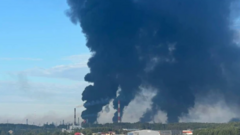
The strikes, which unfolded recently, saw the Slavneft-Yanos refinery in Russia's Yaroslavl region engulfed in flames. Regional governor Mikhail Evraev characterized this incident as the "largest enemy drone attack" in the area, noting that four individuals sustained injuries. Meanwhile, Ukraine reported a devastating toll from Russian assaults, with at least 11 fatalities across various regions and the southern city of Kherson experiencing a complete blackout.
Strategic Rationale Behind Ukraine's Deep Strikes
By Decode Today News
President Zelensky elaborated on the geographical reach of Ukraine's latest attacks, highlighting the considerable distances involved. The Bashneft-Novoil refinery, situated in Russia's Bashkortostan republic, was struck approximately 1,300km (808 miles) from the Ukrainian border. The Slavneft-Yanos refinery, conversely, is located nearly 700km (435 miles) away. These deep penetration strikes suggest a deliberate strategy to target critical economic infrastructure far from the immediate conflict zones, aiming to impact Russia's financial capacity.
Beyond land-based targets, Ukraine also asserted that "two military patrol boats and shadow fleet vessels were hit" in the Black Sea. This "shadow fleet," as described by President Zelensky, comprises tankers reportedly used by Russia for the illegal export of sanctioned oil. Such maritime strikes could disrupt a crucial channel of revenue for Moscow, further complicating its economic operational resilience under international sanctions. President Zelensky emphasized that these Ukrainian actions were "strengthening chances for diplomacy," urging Russia to "choose peace."
Understanding the Mechanics of Oil Revenue Targeting
Targeting oil refineries and associated export infrastructure, like the "shadow fleet," represents a calculated effort to undermine Russia's financial stability. Oil and gas revenues are a significant component of the Russian state budget, directly financing military operations. By striking these facilities, Ukraine aims to diminish Moscow's capacity to maintain its war effort, indirectly influencing the conflict's duration and intensity. This approach seeks to impose a substantial cost efficiency burden on Russia's military-industrial complex and its ability to procure necessary supplies.
In response to the attacks, Yaroslavl regional governor Evraev reported that 93 drones were intercepted or shot down over the Yaroslavl region overnight. He confirmed that "falling debris hit the oil refinery's storage tanks," and emergency services were actively working to extinguish the resulting fire. BBC Verify independently corroborated social media footage and images depicting extensive smoke plumes and at least four distinct fires at the refinery site, affirming the scale of the damage. Energy-generating infrastructure in Yaroslavl has been a repeated target for Ukrainian forces. Authorities in Bashkortostan have yet to issue a public statement regarding the reported attack on the Bashneft-Novoil refinery.
Escalating Infrastructure Warfare
The latest incidents reflect an intensifying pattern of mutual attacks on critical infrastructure by both Russia and Ukraine. Russia, in turn, stated it targeted Ukraine's fuel, energy, and transport facilities, as well as drone storage sites. This escalation aligns with recent weeks seeing both nations increase strikes on major cities, energy installations, and warehouses, even as the extensive front line remains largely static and diplomatic efforts to end the conflict have yielded no significant breakthroughs since the full-scale invasion launched by Russian President Vladimir Putin in February 2022.
The Russian military claimed its forces intercepted or shot down 605 Ukrainian drones overnight across various regions, indicating a widespread and coordinated Ukrainian drone campaign.
The Global Implications of Infrastructure Targeting
The sustained targeting of energy and transport infrastructure carries profound implications, not only for the belligerent nations but also for global supply chain security and market stability. Disruptions to oil production and export capacity, even if temporary, can have ripple effects on international energy markets, potentially influencing prices and availability. This form of economic warfare, while intended to cripple an adversary's funding, often has broader macroeconomic consequences that extend beyond the immediate conflict zone.
Humanitarian Impact and Civilian Resilience
On the Ukrainian side, Russian attacks have inflicted severe humanitarian consequences. The country's state emergencies service, DSNS, reported that three people were killed in the north-eastern town of Balakliya, Kharkiv region, during an overnight Russian drone attack. Private residential houses were targeted, with fires breaking out in two buildings. Kharkiv regional head Oleh Synehubov later confirmed that an additional two individuals died when drones struck a train station in Lozova, injuring another eight.
Further south, five people lost their lives in Russian strikes on the central Dnipropetrovsk region. The city of Kherson experienced a complete loss of electricity after a "critical infrastructure facility" was hit overnight, according to regional head Oleksandr Prokudin. Internet monitoring group NetBlocks observed a "deep disruption" to connectivity in the Kherson region, with internet access dropping to approximately 31% at its lowest point overnight. While connectivity had recovered to about 69% by 12:00 GMT, the situation was ongoing. Isik Mater, NetBlocks' head of research, attributed the partial maintenance of connectivity to the use of "generators and backup supplies" in Kherson, a city that last year reportedly housed 66,000 people, representing about 25% of its pre-war population.
In Ukraine's Black Sea port of Odesa, one person was killed when Russian forces struck two dry cargo ships. These incidents highlight the severe and ongoing toll of the conflict on civilian lives and essential services, challenging the operating margin and operational continuity of key urban areas.
Analyzing the Persistent Stalemate
Despite the intensified attacks on critical infrastructure and the tragic loss of life, the broader strategic landscape remains characterized by a "virtually static" front line. This operational stalemate, coupled with the continued lack of breakthrough in mediation efforts, suggests a protracted conflict where both sides are attempting to gain leverage through attrition and economic pressure rather than significant territorial gains.
The recent events underscore a strategic shift towards targeting deep-seated logistical and economic assets, moving beyond front-line engagements. This escalation, while aiming to impact war financing and military capabilities, also invariably elevates the risk to civilian populations and introduces new complexities to the international discourse surrounding the conflict.
Key Developments and Impacts
The recent escalation underscores a complex interplay of military strategy, economic pressure, and humanitarian impact. Key points from the recent developments include:
- Targeted Refineries: Ukrainian forces struck Bashneft-Novoil (1,300km from border) and Slavneft-Yanos (700km from border), aiming to curb Russian oil revenues.
- Black Sea Operations: Attacks on "two military patrol boats and shadow fleet vessels" in the Black Sea signal efforts to disrupt sanctioned oil exports.
- Russian Defense: Russia claimed to have shot down 93 drones over Yaroslavl region and a total of 605 Ukrainian drones overnight.
- Ukrainian Casualties: Russian attacks resulted in at least 11 deaths across Ukraine, including in Balakliya, Lozova, Dnipropetrovsk, and Odesa.
- Infrastructure Damage: Kherson experienced a total blackout and significant internet disruption, affecting its remaining population of 66,000.
- Strategic Context: Both sides intensify attacks on critical infrastructure while the front line remains largely static, and diplomatic solutions are elusive.
The conflict continues to evolve, with profound implications for both nations' long-term economic stability, cybersecurity risk, and the safety of their populations.


