Saudi Arabia Turkey and Pakistan Sign Defense Pact
In a significant geopolitical development, Saudi Crown Prince Mohammed bin Salman, Turkish President Recep Tayyip Erdogan, and Pakistani Prime Minister Shehbaz Sharif recently formalized a joint defense agreement in Mecca, Saudi Arabia. This pact asserts that any armed attack against one of the three nations would be considered an attack against all, aiming to bolster collective deterrence in an increasingly volatile region.
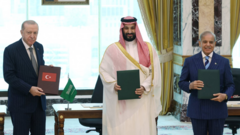
The new accord, dubbed the Mecca Joint Defense Agreement, brings together three of the world's most influential Muslim-majority nations. A joint statement on the pact emphasized its objective "to strengthen collective deterrence against any act of aggression, and stipulates that any armed attack against any one of the three States shall be regarded as an attack against them all." Furthermore, it commits the signatories to "the enhancement of all aspects of defence co-operation among the three States." This strategic alignment follows a similar joint defense pact announced last year between Saudi Arabia and Pakistan.
Regional Security Architecture Under Scrutiny
By Decode Today News
The signing comes amidst heightened tensions in the Middle East and surrounding areas. Recent events, including the February 28 attacks on Iran by the US and Israel, which subsequently led Tehran and its allies to strike targets in Saudi Arabia and other Gulf states, have dramatically altered the regional security landscape. These retaliatory actions disrupted vital shipping lanes through the Strait of Hormuz and the Red Sea, critical conduits for global oil traffic. For Saudi Arabia, this pact represents a strategic response to these destabilizing forces.
The Kingdom has faced direct threats, including a "maritime embargo" announced last month by Yemen's Iran-backed Houthi rebels, who control significant parts of northwestern Yemen. The Houthis have also targeted Saudi airports, oil facilities, and tankers in the Red Sea. Adding to Saudi Arabia's security concerns were last year's Israeli strikes on Doha, which targeted senior Hamas officials, contributing to a broader recalibration of defense strategies across the Gulf states, as noted in a report last year by the Centre for Strategic and International Studies.
Understanding the Mechanics of Saudi Arabia Turkey and Pakistan's Defense Pact
While the concept of a mutual defense agreement between Saudi Arabia, Turkey, and Pakistan appears straightforward on the surface, its practical implementation involves complex calculations and careful diplomacy. The pact explicitly pledges mutual support but does not provide specific details on the obligations of each party in various scenarios. A Turkish official, quoted by Reuters news agency, described the pact as "purely defensive in nature," underscoring its foundational intent.
For example, should Saudi Arabia's full-scale conflict with the Houthis resume, it remains uncertain whether Turkey would be obliged to join military strikes on Yemen. Similarly, a re-emergence of conflict between Pakistan and India could raise questions about Saudi Arabia's commitment to declare war on India. Each hypothetical instance would necessitate intricate diplomatic maneuvers, often aimed at de-escalation rather than direct military involvement. The primary underlying concept, however, is deterrence. The sheer weight of three regional powers standing together aims to make aggression against any signatory far more costly, thereby discouraging potential adversaries.
Strategic Imperatives for Each Nation
Each of the three signatory nations brings distinct capabilities and motivations to this alliance, aligning their strategic interests for mutual benefit:
- For Saudi Arabia: The pact offers an enhanced level of security in a region where existing security architectures have been upended. It serves as a vital component of the Kingdom's evolving defense strategies, particularly in the face of persistent threats from actors like the Houthi rebels and the broader implications of geopolitical shifts involving Iran, the US, and Israel. This collective security framework aims to bolster national resilience and safeguard critical infrastructure and trade routes.
- For Pakistan: This agreement provides crucial, complementary benefits. With its long-standing tensions with India having flared into open conflict in May 2025 – though an all-out war was averted – the prospect of having the considerable economic muscle of Saudi Arabia and the military and industrial might of Turkey in its corner is increasingly valuable. This alliance further cements Pakistan's growing role in global diplomacy, building on its recent activities as an intermediary between Iran and the US and its hosting of ceasefire negotiations, which have significantly elevated its regional status.
- For Turkey: The benefits are primarily centered on its burgeoning defense industries. Burcu Ozcelik from the London-based Royal United Services Institute (Rusi) highlights opportunities for "joint production, technology partnerships, procurement and greater military interoperability." This strategic cooperation can lead to significant advancements in defense technology and expand market valuation for Turkish defense enterprises, fostering innovation and economic growth within the sector.
Implications of the New Alliance
The formation of the Mecca Joint Defense Agreement by Saudi Arabia, Turkey, and Pakistan has drawn varied international reactions. In Tehran, senior member of parliament Ebrahim Rezaei, of the National Security commission, sharply criticized the pact. On his X account, Rezaei stated, "The Saudis should know that a paper agreement with Turkey and Pakistan does not bring them security, just as years of unilateral milking of the Americans did not bring them security." This comment underscores a perception within some Iranian circles that the pact will not significantly alter the balance of power or Saudi Arabia's security posture.
Despite these criticisms and the inherent complexities of mutual defense obligations, the overarching goal of this alliance is deterrence. By forming a united front, Saudi Arabia, Turkey, and Pakistan aim to create a stronger bulwark against aggression, thereby influencing the cost-benefit analysis for potential adversaries. The pact seeks to solidify the collective security framework among these nations, potentially impacting regional power dynamics and global security discussions.
As these nations embark on enhanced defense cooperation, the market valuation of their respective defense sectors could see long-term benefits through increased R&D investment, joint ventures, and expanded procurement opportunities. The agreement also reflects a broader trend of regional powers seeking to forge new alliances and recalibrate their foreign policy to address evolving geopolitical challenges and secure their national interests. This strategic move by Saudi Arabia, Turkey, and Pakistan highlights a proactive approach to collective security in a world defined by rapid and often unpredictable shifts in power and influence.


