US Pledges $1bn as Colombia's New President Takes Office
Colombia's new right-wing populist president, Abelardo de la Espriella, was sworn into office on Friday, hours before the US pledged a $1 billion (£740 million) security package to the South American nation. De la Espriella, an admirer of former US President Donald Trump, used his maiden speech to declare an "all-out war" on drug cartels and organized crime, echoing Trump's prior criticisms of Colombia's approach to drug flows and illegal immigration.
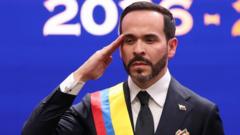
The US State Department confirmed the "security package" aims to assist Colombia in achieving "our shared goals," which prominently feature combating organized crime and stemming illegal immigration. This significant financial commitment underscores a renewed strategic alignment between Washington and Bogotá, particularly under a leadership that shares many political philosophies with past US administrations.
New Leadership, Firm Stance: De la Espriella's Vision for Colombia
By Decode Today News
In his inaugural address, delivered at a military base, President de la Espriella, who has styled himself "El Tigre" (the Tiger), promised a forceful and decisive state response against criminal elements. He declared, "There will not be a single place in our territory where criminals can feel safe," signaling a radical departure from his predecessor's policies. A lawyer and businessman, de la Espriella has positioned himself as a "maverick outsider," vowing to combat crime with an "iron fist" and refusing to govern with what he called "the usual suspects" – a reference to Colombia's pre-Petro political elite.
His hardline approach draws comparisons to similar crackdowns by other right-wing populist leaders in the region, such as Nayib Bukele in El Salvador and Daniel Noboa in Ecuador. These regional shifts reflect a broader trend in Latin American nations moving rightward amid economic hardship and escalating concerns over gang violence and public security.
A Shift from "Total Peace" to "All-Out War"
De la Espriella's agenda stands in stark contrast to his predecessor, Gustavo Petro, who pursued a "total peace" strategy. Petro's approach prioritized negotiation with guerrilla groups and cartels and incentivized farmers to cease coca cultivation. Critics, however, argue that this method failed, pointing to the expansion of armed groups in recent years and a brutal conflict along the Colombia-Venezuela border that displaced tens of thousands of people.
The new president has explicitly pledged to abandon the "total peace" strategy, signaling a profound change in Colombia's internal conflict resolution and national security policy. This policy pivot is expected to have significant implications for regional stability and the dynamics of criminal organizations.
Strengthening US-Colombia Ties and Regional Alliances
The US government, under the Trump administration, had repeatedly criticized Petro's policies, blaming them for the flow of drugs and illegal migrants into the United States. Before de la Espriella's election in June, former President Trump had expressed "total support and strength of the United States behind him," predicting a "much better relationship" with Colombia under the new leadership.
One of President de la Espriella's first acts in office was to announce Colombia would join the "Shield of the Americas" security partnership, an initiative founded by Trump. The US State Department welcomed this move, highlighting that de la Espriella's "pro-growth agenda" presented an opportunity to "increase trade and deepen economic ties between our countries." This aligns Colombia with other right-wing governments in the region, such as Argentina under libertarian President Javier Milei, who has also sought closer ties with the Trump administration.
The US had previously provided Argentina with a $20 billion US Treasury bailout, with Trump indicating his support for Argentina was contingent on Milei remaining in power, contrasting with threats against Cuba's Communist government. De la Espriella has also pledged a strong military alliance with the US and Israel, marking another significant policy divergence from Petro, who cut ties with the Israeli government over its offensive in Gaza and advocated for the Palestinian cause.
Understanding the Mechanics of a New Presidency
The transition of power to President de la Espriella signifies a fundamental recalibration of Colombia's domestic and international policy frameworks. His presidency is characterized by a commitment to law and order, a robust crackdown on organized crime, and a reorientation of foreign policy towards stronger alliances with the US and Israel. This shift is not merely symbolic; it represents a strategic adjustment aimed at bolstering national security, enhancing economic stability through aligned partnerships, and reasserting state authority.
For investors and businesses, a "pro-growth agenda" coupled with increased stability could present new opportunities, particularly in sectors benefiting from enhanced security and economic integration. However, the aggressive stance against armed groups might also entail short-term disruptions, raising questions about compliance security and operating margin for businesses in affected regions. The US pledge of $1 billion for security infrastructure reflects a significant investment yield expectation for both nations, aiming to reduce cybersecurity risks and illicit trade activities, thereby bolstering consumer demand and market valuation.
De la Espriella's Path to Power and Regional Impact
President de la Espriella's journey to the presidency has been unconventional. A US citizen since 2023, having lived and worked in Miami for years, he announced his candidacy following the assassination of another conservative candidate. He frequently appeared at rallies wearing a bulletproof vest and behind bulletproof glass, underscoring the high-stakes political environment. His choice to take the oath of office in Cali, rather than the capital Bogotá, was a deliberate signal of his desire to distance himself from traditional centralized politics.
Interestingly, his professional background includes a successful career as a defense lawyer for drug-trafficking paramilitaries – precisely the types of criminals he now intends to imprison. This personal history adds a complex layer to his "iron fist" rhetoric.
De la Espriella's ascension, alongside that of Keiko Fujimori in Peru, signals a dwindling number of left-wing leaders in Latin America, potentially isolating figures like Brazil's Luiz Inácio Lula da Silva. Regionally, the political landscape continues to evolve, with upcoming electoral contests, such as the one involving Flávio Bolsonaro, son of former far-right populist President Jair Bolsonaro, further shaping the continent's ideological alignment.
Key Policy Shifts and International Engagements Under President de la Espriella
The new presidency brings a clear set of policy redirections and international commitments. These shifts are poised to reshape Colombia's domestic governance and its standing on the global stage.
- National Security: Abandonment of the "total peace" strategy in favor of an "all-out war" on drug cartels and organized crime, utilizing an "iron fist" approach.
- International Alliances: Strengthened military and political ties with the US and Israel, including joining the "Shield of the Americas" security partnership.
- Economic Focus: Commitment to a "pro-growth agenda" aimed at increasing trade and deepening economic ties, particularly with the US.
- Regional Politics: Contribution to the broader rightward shift in Latin America, potentially isolating remaining left-wing leaders.
- Domestic Governance: Emphasis on reasserting state authority across all territories and combating crime decisively.
The immediate infusion of $1 billion in US aid highlights the strategic importance placed on this new partnership, signaling a period of significant change and reorientation for Colombia under President Abelardo de la Espriella.


