US Accuses Nations of Aiding China Tariff Evasion
The White House revealed in a report on Thursday that more than 40 countries have allegedly assisted China in circumventing US tariffs by rerouting exports through nations that benefit from lower American import duties. Among the countries specifically named in the extensive report are Canada, India, Mexico, Japan, and South Korea, which the US government asserts have collectively enabled China to evade tens of billions of dollars in tariffs, significantly impacting American economic interests.
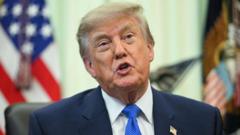
White House trade adviser Peter Navarro directly attributed a substantial cost to this alleged practice, stating it has led to the loss of "American jobs and billions in revenue." This high-stakes accusation emerges weeks before a critical meeting between President Donald Trump and Chinese leader Xi Jinping in Washington, adding a fresh layer of tension to already fraught trade relations.
In response to inquiries, a spokesperson for the Chinese embassy in Washington strongly defended its position, asserting that "trade wars have no winners" and reiterating China's opposition to the US' tariff measures. The spokesperson further condemned the use of state power to target Chinese companies and emphasized that "any unilateral actions or agreements concerning transshipped goods must not target or harm the interests of third parties." The BBC has reportedly contacted the US embassies of the implicated countries and other trading partners listed in the report for their official comments.
The Mechanics of Tariff Evasion: Transshipment Exposed
By Decode Today News
At the core of the White House's allegations is the practice known as transshipping. This refers to the process of transferring cargo through an intermediate country while it is en route to its ultimate destination. While transshipping itself is a legitimate logistical method, the US report accuses China of "taking advantage" of this practice by strategically moving goods through nations that have substantially lower tariff rates with the United States. This complex maneuver, according to the White House, involves using third countries as a mere stopover point, where goods are often repackaged to intentionally obscure their genuine origin, thereby qualifying for reduced tariffs upon entry into the US market.
The report vividly describes this elaborate process as nothing less than "fraud cloaked in paperwork." It further elaborates on the contemporary evolution of this evasion, noting, "What has changed in today's Great Transshipment Scam is not merely the speed and scale of this modern form of smuggling, but the breadth, depth, and sophistication of the global Shadow Transshipment Network through which China's tariff evasion now moves." The scale of this alleged evasion is staggering; government and private sector estimates cited by the White House suggest that goods valued between $30 billion (£22.2 billion) and roughly $300 billion have been illicitly moved from countries with higher tariffs through those with lower rates.
Understanding Tariff Evasion and its Economic Impact
Tariff evasion through sophisticated transshipment schemes poses significant challenges to global trade integrity and fair competition. For businesses operating within the United States, such practices directly impact their `operating margin` and `consumer demand` by creating an uneven playing field where foreign competitors might enjoy artificial cost advantages. The ability to bypass tariffs through a "Shadow Transshipment Network" directly undermines the `compliance security` intended by trade policies, leading to substantial revenue losses for the importing nation and unfair competition for domestic industries.
The White House's report underscores the financial implications, stating the practice has cost "billions in revenue" and "American jobs." This economic drain is a primary driver behind the US administration's aggressive posture on trade. The deployment of advanced `AI tools` by the US government to detect these transshipment efforts highlights a technological arms race in trade enforcement, leveraging `AI infrastructure` to combat complex financial schemes that exploit loopholes in international trade agreements.
The `cost efficiency` sought by entities engaged in tariff evasion is often at the expense of national economies and the legitimate businesses that adhere to trade regulations. This dynamic creates a ripple effect, potentially distorting `market valuation` for entire industries and dampening innovation where fair competition is compromised.
Advanced AI Deployed to Combat Evasion
In a significant development for trade enforcement, the US has begun deploying artificial intelligence (AI) tools specifically designed to detect and counter these sophisticated transshipment efforts. This technological intervention reflects the increasing complexity of tariff evasion schemes and the necessity for advanced analytical capabilities to identify patterns and anomalies indicative of fraudulent activity within vast global trade data. The use of AI is intended to enhance the efficiency and accuracy of identifying goods that are intentionally mislabeled or rerouted to conceal their true origin, representing a modern approach to `compliance security` in an increasingly digital world.
Heightened Tensions Ahead of Trump-Xi Meeting
The release of this report is expected to become a key sticking point in the upcoming discussions between President Trump and Chinese leader Xi Jinping. The meeting, scheduled for September in the US, arrives amid a period of persistent trade friction, despite a pause in most tariffs following talks in May 2025. Washington and Beijing have continued to engage in a series of tit-for-tat sanctions, underscoring the ongoing trade war.
Recent examples of these escalating restrictions include US limitations on the import of humanoid robots from specific regions and tighter Chinese curbs on the export of certain drone technologies. These measures highlight a broader competition across critical `technology` and `AI` sectors, extending beyond traditional goods to encompass advanced digital and robotic components.
The Trump administration's commitment to tariffs as a strategic tool to bolster American jobs and the economy has been a cornerstone of its trade policy. In April 2025, President Trump unveiled sweeping levies on dozens of US trading partners, a policy rooted in his long-held belief in the protective power of tariffs. While some of these sanctions were subsequently struck down by the US Supreme Court, the administration has consistently introduced new tariffs using alternative legal mechanisms, signaling an unwavering commitment to this signature economic policy.
Key Takeaways from the White House Report
- Accused Nations: Over 40 countries, including Canada, India, Mexico, Japan, and South Korea, are implicated in aiding China.
- Financial Impact: An estimated $30 billion to $300 billion in goods have been transshipped, leading to "tens of billions of dollars" in evaded tariffs and costing "American jobs and billions in revenue."
- Method: The practice of transshipping goods through lower-tariff countries, often involving repackaging and concealing true origin, described as "fraud cloaked in paperwork" and a "global Shadow Transshipment Network."
- US Response: Deployment of advanced AI tools to detect and combat tariff evasion efforts.
- Geopolitical Context: The report intensifies trade tensions ahead of a critical meeting between President Trump and Chinese leader Xi Jinping in September, following ongoing sanctions on `technology` like humanoid robots and drone exports.
- China's Stance: Chinese embassy states "trade wars have no winners" and opposes US tariff measures, arguing unilateral actions must not harm third parties.


