Meta Unveils Muse Code AI Coding Agent Beta
Meta's Muse Code Enters Beta, Challenges AI Coding Rivals
By Decode Today News
Meta has announced the early beta release of Muse Code, a new terminal-based coding agent designed to intensify competition within the burgeoning artificial intelligence (AI) software development sector. This innovative tool is explicitly positioned to rival established offerings such as Anthropic's Claude Code and OpenAI's Codex, aiming to capture a significant share of the market for automated software engineering solutions.
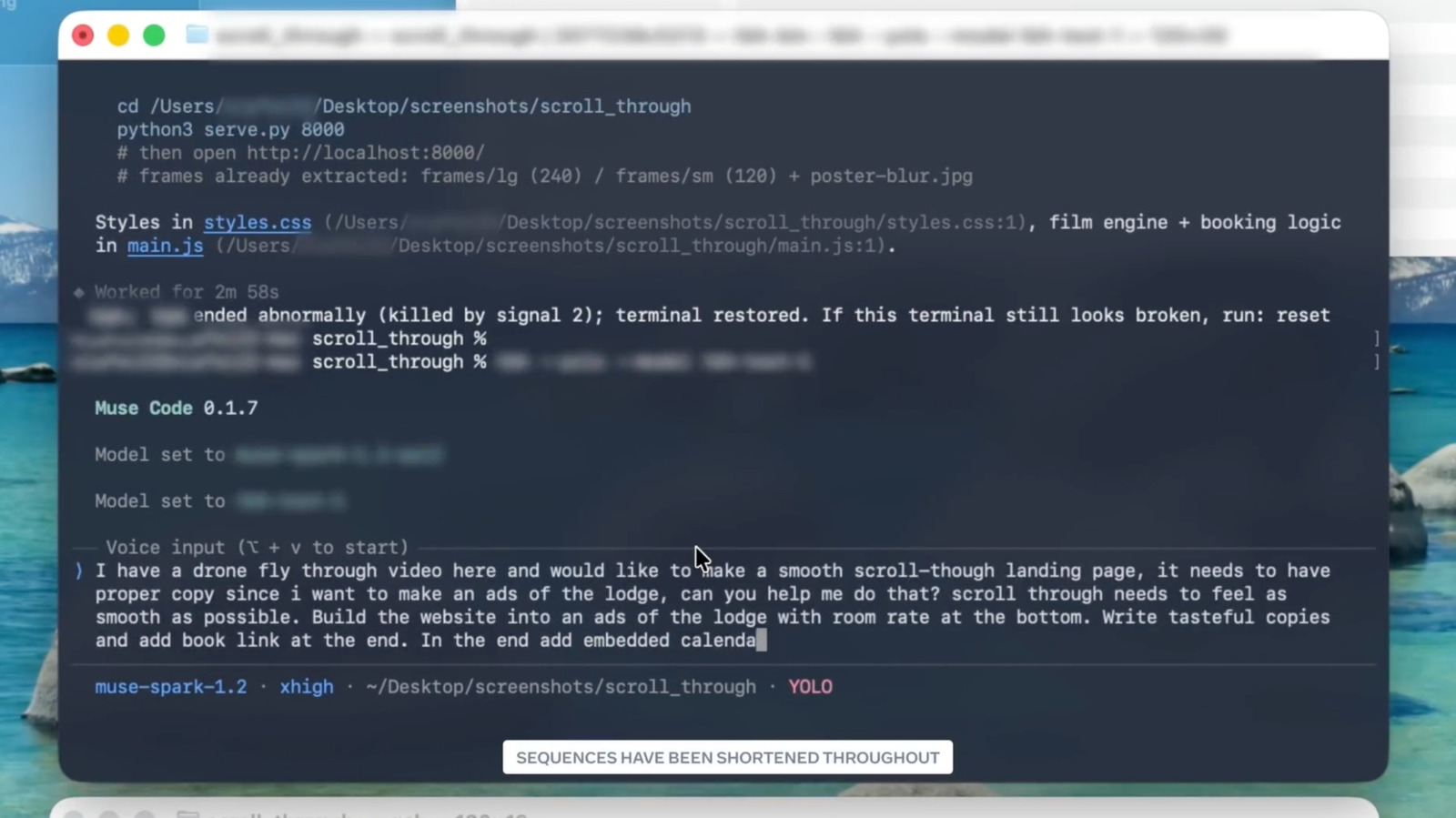
Powering Muse Code is Muse Spark 1.2, a new iteration of Meta's proprietary AI model. The company states that this updated model brings "improvements in code generation, complex debugging, codebase understanding, and end-to-end developer workflows," signaling a concerted effort to enhance developer productivity and streamline the software development lifecycle from initial concept to deployment.
Understanding the Mechanics of Meta's Muse Code
At its core, Muse Code is engineered to handle a broad spectrum of software engineering tasks, enabling developers to build functional software through intuitive text prompts. Much like its competitors, the agent is adept at fundamental programming activities, including writing new code from scratch, planning intricate architectural changes within existing systems, and rigorously validating the results of its generated solutions. This capability positions Muse Code as a comprehensive assistant, potentially transforming how development teams approach iterative design and testing, thereby enhancing `developer efficiency` and `enterprise integration`.
A key architectural feature highlighted by Meta is Muse Code's ability to manage multiple sub-agents. This allows the system to delegate specific tasks more efficiently, fostering a modular approach to complex projects. Such an internal delegation mechanism is crucial for tackling larger, multi-faceted software challenges, promising to accelerate development timelines and improve the overall efficiency of large-scale projects, impacting both `operating margin` and `time-to-market` for new applications.
Meta's announcement included several compelling sample projects designed to showcase the versatility and power of Muse Code. These demonstrations illustrate the agent's capability across diverse applications:
- An interactive model of a photon sphere, highlighting its aptitude for complex scientific or graphical simulations, indicative of its potential in specialized `AI infrastructure` applications.
- A Plants vs. Zombies knockoff, demonstrating its capacity for game development and interactive application creation, pointing to broad utility in `consumer demand`-driven software.
- A demo video illustrating the tool's ability to build a fully functional webpage solely based on an MP4 file, showcasing its utility in multimedia processing and automated web development, and simplifying complex `cloud migration` tasks.
These examples underscore Muse Code's potential to significantly reduce the manual effort involved in various development stages, from conceptualization and prototyping to deployment and maintenance, thereby boosting overall `developer productivity`.
Strategic Affordability: Meta's Competitive Edge
A defining characteristic and a primary differentiator for Muse Code in the competitive AI landscape appears to be its strategic emphasis on affordability. Meta aims to undercut existing market leaders through aggressive pricing, making advanced AI coding capabilities more accessible to a wider range of developers and enterprises. This move directly addresses `cost efficiency` as a critical factor for adoption.
The company confirmed that Muse Code would default to the same pay-as-you-go pricing model as its underlying AI engine, Muse Spark. This standard tier is priced at $1.25 per million input tokens and $4.25 per million output tokens. For many enterprises, these rates represent a significant consideration for their ongoing `AI infrastructure` expenditures and `operating margin` planning, especially as AI adoption scales.
Further enhancing its value proposition, Meta's Chief AI Officer, Alexander Wang, stated in an interview with CNBC that the company intends to offer a "contributor tier." This tier, as detailed by The Wall Street Journal, would grant users access at a "significantly lower cost" in exchange for their agreement to provide feedback aimed at improving the coding agent. This symbiotic relationship could accelerate Muse Code's development and refinement while providing substantial cost savings to early adopters, creating a unique value proposition for businesses focused on `investment yield` from their tech spend.
The pricing for this contributor tier is set at an exceptionally competitive rate: $0.10 per million input tokens and $0.20 per million output tokens. This pricing strategy reflects a clear move by Meta to disrupt the market by targeting the economic sensitivities of developers and businesses, especially those grappling with escalating AI service costs. This could significantly lower the barrier to entry for widespread `AI adoption`.
Comparative Cost Analysis: Muse Code vs. Anthropic Sonnet 5
To put Meta's pricing strategy into perspective, a direct comparison with a prominent competitor highlights the significant cost advantage Muse Code seeks to establish. Anthropic's Sonnet 5 model, for instance, typically costs $3 per million input tokens and $15 per million output tokens. The table below outlines this stark contrast:
| AI Model/Tier | Input Tokens (per million) | Output Tokens (per million) |
|---|---|---|
| Meta Muse Code (Standard) | $1.25 | $4.25 |
| Meta Muse Code (Contributor Tier) | $0.10 | $0.20 |
| Anthropic Sonnet 5 | $3.00 | $15.00 |
As the figures demonstrate, the contributor tier for Muse Code is dramatically cheaper, potentially offering savings of over 95% on input tokens and over 98% on output tokens compared to Anthropic's Sonnet 5. Even the standard Muse Code pricing presents a substantial reduction in costs, underscoring Meta's aggressive play for market share through `cost efficiency` and optimized `investment yield`.
Should Muse Code perform effectively and meet the expectations set by its technical specifications, this considerable price differential could become a decisive factor for companies evaluating AI coding agents. The economic advantage could compel many organizations to choose Meta's offering over more expensive alternatives, directly impacting `market valuation` and `enterprise integration` strategies across the tech ecosystem.
This strategic approach to pricing has precedent. The company notes that similar logic has already proven effective in the Chinese AI market, where numerous companies have transitioned to domestic models, such as DeepSeek, to circumvent the rising costs associated with using US-based AI tools. Meta appears to be applying a similar competitive pricing strategy to gain traction globally, aiming to attract developers and businesses seeking to optimize their `AI investment yield` without compromising on capability.
Implications for the AI Development Landscape
The introduction of Muse Code by Meta signifies a pivotal moment in the competitive landscape of AI-powered developer tools. By combining advanced AI model capabilities with an aggressive pricing structure, Meta is not only challenging incumbents but also setting new benchmarks for `developer accessibility` and `cost-effectiveness` in the domain of automated code generation and debugging. This move could reshape `consumer demand` for AI solutions.
For businesses, the availability of a more affordable yet powerful coding agent could significantly impact their software development budgets and project timelines. Enhanced `developer efficiency` through tools like Muse Code translates directly into faster time-to-market for new products and features, potentially boosting market competitiveness and fostering innovation. Furthermore, the capacity for complex debugging and codebase understanding suggests a tool that can contribute to improved software quality and reduced `cybersecurity risk` through more robust and secure code generation, aligning with `compliance security` standards.
Meta's entry also underscores the ongoing arms race in `AI infrastructure` development. As major tech companies like Meta, OpenAI, and Anthropic continue to innovate, the focus is shifting beyond raw model power to practical application, economic viability, and the seamless integration into existing developer workflows. Muse Code, with its terminal-based interface, aims for a familiar and intuitive experience for software engineers, facilitating smoother `enterprise integration`.
The success of Muse Code will ultimately hinge on its real-world performance and the perceived value by the developer community. If it delivers on its promises of "improvements in code generation, complex debugging, codebase understanding, and end-to-end developer workflows" at its highly attractive price points, Meta could fundamentally reshape the dynamics of the AI coding agent market, driving further innovation and potentially ushering in an era of even greater affordability and capability in AI-assisted software development, influencing global `market valuation` for AI services.


