AI & Drones Transform Wildfire Tech Response
Next-Gen Tech Boosts Wildfire Detection, Early Response
By Decode Today News
As devastating wildfires continue to plague regions like France's Gironde, Spain, and Portugal, forcing hundreds of thousands from their homes and claiming the lives of firefighters, the traditional human-centric approach to combating these infernos is undergoing a significant technological transformation. While the fundamental techniques for extinguishing fires have remained largely consistent, advanced tech, particularly in detection and early intervention, is reshaping how authorities respond, offering critical minutes that can differentiate between a localized incident and a widespread catastrophe.
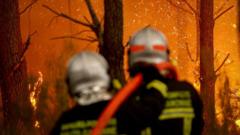
Chief sergeant Guillaume Millet, a firefighter with 24 years of experience who heads the Fire and Rescue Service branch of the CFDT union in the wildfire-stricken Gironde region, highlights this shift. "The big change, especially in my département, is that now we've got cameras assisted by artificial intelligence to watch the forest and see where fires are starting," Millet said. This adoption of AI infrastructure marks a strategic move from seasonal human lookouts to an automated, more precise surveillance system.
AI-Powered Surveillance: A New Era in Forest Monitoring
In areas like the Gironde, AI-assisted cameras have entirely replaced the human lookouts previously stationed in watch towers across towns during summer months. This innovative integration of artificial intelligence offers considerable advantages, primarily by significantly reducing false alarms. An AI-assisted camera, Millet explained, "can distinguish with almost total certainty between smoke and dust thrown up by a tractor in a field, for example." Beyond this accuracy, these systems boast an impressive operational range, capable of detecting fires up to 20 kilometers (12 miles) away, providing an unprecedented lead time that is crucial for effective wildfire management.
The implementation of these sophisticated systems is spearheaded by companies like Midgard in Gironde and the French start-up FireTracking in other parts of France. Jean-Simon Chaudier, CEO of FireTracking, detailed the rapid response mechanism. "As soon as the system detects a fire, there's an alert on the fire fighters' telephones. They open the application and see what the camera is seeing with a x40 [40 times] zoom," Chaudier explained. Complementing this real-time visual feed is a dynamic map displaying the fire's exact location, positions of nearby structures, and a simulation predicting its minute-by-minute spread, factoring in weather conditions and humidity levels.
Understanding the Mechanics of Tech in Wildfire Response
The strategic deployment of AI in wildfire detection leverages sophisticated algorithms trained on vast datasets of visual information to identify smoke plumes and early signs of fire. These systems often integrate with existing communication networks to provide instant alerts. The immediate benefits include enhanced situational awareness, optimized resource allocation, and a substantial improvement in response times, translating directly into better cost efficiency and reduced ecological impact. The data collected by these systems also contributes to long-term predictive modeling and strategic planning for fire prevention.
The Critical 15-Minute Advantage and Cost Efficiency
The speed offered by AI detection translates into tangible results on the ground. Chaudier emphasized the vital role of every minute saved. "For the past 10 days, for example, we have the feedback from a firefighter that our AI detected seven fires 15 minutes before the first phone call," he stated. This 15-minute lead, Chaudier asserted, "is the difference between a catastrophe and a fire which can be limited to two or three hectares." He likened this to the escalating needs of suppression: "After one minute you can put out a fire with a glass of water, after two you need a tank of water, after three minutes you need to send a Canadair."
The investment in such technology promises significant returns by mitigating larger, more destructive, and far costlier blazes. FireTracking's cameras currently survey a staggering 1 million hectares, primarily across France. In the French département of Indre-et-Loire, the company installed 11 detection sites, covering a 6,000 square kilometer (2,300 square miles) area. The total investment for this comprehensive coverage was approximately €1.2 million ($1.4 million; £1 million). This region, largely agricultural, faces a severe problem with crop fires, experiencing around 300 such incidents annually, making the AI system a crucial tool for both environmental protection and agricultural economic stability.
Emerging Drone Technologies and Future Capabilities
The evolution of AI fire detection is expected to accelerate. The French civil protection service is advancing a program called Condor, which involves testing solar-powered drones equipped with electro-optical cameras and AI for continuous, autonomous patrols. Spain's SenForFire project further explores prevention by placing sensors among trees to measure gases released *before* flames become visible, offering an even earlier warning system.
While drones are proving effective in areas like sea rescue – dropping lifebuoys and survival kits – their direct application in active firefighting remains in development. However, several innovative projects are underway:
- Heavy-lifting drones: French start-up Daidelos is seeking investment for a petrol-engine drone capable of hovering over fires and spraying up to 1.2 tonnes of water. This could serve as a vital autonomous first-response unit.
- Grenade-dropping drones: Other companies are developing drones that release specialized grenades. These devices explode upon contact with extreme heat, blanketing the surrounding area with a chemical powder designed to smother, cool, and interrupt the fire's combustion chemistry. The ambition is to create an autonomous rapid-response system where detection and drone activation can extinguish fires at their nascent stages.
- Information-gathering drones: Researchers are also developing drones capable of flying close to active flames not to extinguish them, but to gather critical real-time information. These drones would assess immediate risks – such as dense smoke, sudden weather shifts, or the collapse of burning trees and structures – before human firefighters deploy, enhancing both operational efficiency and compliance security for ground crews.
The Indispensable Human Element
Despite these technological advancements, the consensus among frontline personnel is that human firefighters remain irreplaceable in direct suppression efforts. Guillaume Millet stressed that the usefulness of technology in actual firefighting is "very limited." He affirmed, "It can help us with detection but it's not technology that puts out fires; you need people to pull the hoses through the forest to attack them."
Even large-scale aerial support, such as a Canadair plane dropping 6,000 liters of water, only reduces a wildfire's intensity. "Firefighters on the ground have to finish what the Canadair started," Millet explained. Similarly, Dash planes that spray fire retardant – typically ammonium phosphate in an orange powder – are strategic tools to slow a fire's spread, but they are "no substitute for the brawn and water brought by troops on the ground."
In conclusion, while cutting-edge tech, particularly AI in early detection and sophisticated drone development, is revolutionizing how wildfires are identified and managed, it fundamentally serves to make the firefighter's job safer and more effective. The ultimate act of extinguishing a blaze, Millet concluded, has remained consistent since the first modern fire brigade in the 1670s: "It's always the firefighters on the ground, pulling the hoses, who extinguish the fires." This fundamental truth, he suggests, is not about to change soon.


