Decode Today News delivers breaking news on AI, tech, business, politics, and world events — updated daily.
breaking news, AI news, technology news, India news, world news, business news #decodetodaynews
Ads
Breaking News
Home/Business/Decode Today/Finance/Warsh Initiates Sweeping Fed Review After Holding US Interest Rates Steady in First Meeting
Warsh Initiates Sweeping Fed Review After Holding US Interest Rates Steady in First Meeting
Warsh Initiates Sweeping Fed Review After Holding US Interest Rates Steady in First Meeting
By Decode Today News
Warsh to review how Fed works after holding US interest rates at first meeting Business
Kevin Warsh has commenced his tenure as Federal Reserve Chair by overseeing a unanimous decision to hold US interest rates between 3.5% and 3.75%, while simultaneously launching a comprehensive review of how the central bank operates. This initial move, following his first rate-setting meeting, signals a new era for the institution amidst elevated inflation and geopolitical uncertainties.
The Federal Open Market Committee (FOMC), the Fed's rate-setting body, maintained the current interest rate corridor despite a notable split among its governors on whether to keep rates steady or increase them further to combat inflation. Inflation, currently running above the Fed's target at 3.8%, has been significantly impacted by the US-Israel war in Iran, pushing energy costs higher. This geopolitical backdrop, coupled with uncertainties surrounding President Donald Trump's efforts to broker a peace deal in the region, influenced the committee's decision.
President Trump, who had previously pressured Warsh's predecessor, Jerome Powell, for interest rate cuts, had made his expectations for Warsh to deliver similar cuts clear. However, facing an above-target inflation rate and the ongoing conflict in the Middle East, the FOMC opted for stability. In a concise statement, backed by all 12 of its members, the committee affirmed: "Economic activity is expanding at a solid pace despite elevated uncertainty that owes, in part, to the conflict in the Middle East. Productivity growth and capital investment are strong. Job gains have kept pace with the workforce, and the unemployment rate has changed little."
A New Era of Fed Communication
A significant shift under Warsh's leadership became immediately apparent in the Fed's communication style. Warsh, a vocal critic of the central bank's previous verbose pronouncements, has advocated for a more direct and less extensive approach. The statement released on Wednesday was a mere 132 words, a stark contrast to the nearly 350-word statement issued in April. This leaner format, Warsh indicated, aims to "just give you the facts as best we can judge it," emphasizing clarity over elaborate forward guidance. "The Committee will deliver price stability," the statement concluded, reinforcing the Fed's core mission.
Crucially, the Fed's latest update also removed any language that might have hinted at future interest rate reductions, a departure from previous communications. This change aligns with the current economic outlook and the sentiments within the committee. The closely watched "dot-plot" grid, which captures individual central bankers' projections for future interest rates, reinforced this sentiment. Nine of the 18 central bankers who participated in the FOMC's rate-setting process predicted an interest rate hike before the end of the year, while only one foresaw a cut. The remaining eight predicted rates would remain unchanged. Warsh, who opposes the "dot-plot" in principle, did not offer his own projection but encouraged his colleagues to proceed with theirs.
Samuel Tombs, chief US economist at Pantheon Macroeconomics, highlighted the "dot-plot" as the "big news" of the day, pointing to a strong possibility of interest rate hikes later in the year. This sentiment suggests that despite holding rates steady now, the inclination within the Fed leans towards tightening monetary policy if inflation pressures persist.
President Trump's Mixed Reaction
President Trump offered a somewhat ambivalent reaction to the Fed's decision. "It's alright… whatever," he stated when asked about the rate hold. When pressed on the potential for future interest rate hikes, he responded with skepticism: "It could happen… it's hard to believe," adding that such hikes "just keeps the country down, it is so unusual."
Despite his long-standing preference for lower interest rates, Trump showered praise on Warsh, his nominee to lead the Fed. "We have a very good guy over there now, so I'm guided by what he wanted," the President remarked, signaling a level of trust in Warsh's judgment, even if it diverges from his own immediate policy preferences. This dynamic underscores the delicate balance between political expectations and the independent role of the central bank in managing the economy.
Warsh's Vision for a Transformed Fed
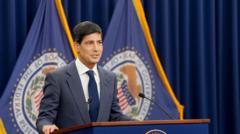
In a post-decision press conference, Warsh articulated his vision for a central bank that is both responsive and efficient. He characterized the change in Fed leadership as "a natural and timely opportunity to reaffirm its mission, to review current practices." He was explicit about his belief that previous forward-looking guidance from the Fed had been unhelpful, often complicating discussions around interest rate and other monetary policy decisions.
To reshape the institution, Warsh immediately launched task forces dedicated to examining five critical areas of the Fed's operations. These include:
* **How the Fed communicates:** Reinforcing the new emphasis on conciseness and clarity, moving away from extensive forward guidance.
* **The size of its balance sheet:** A crucial aspect of monetary policy that expanded significantly during periods of economic crisis.
* **Its use of economic data:** Ensuring the central bank is utilizing the most relevant and timely information to inform its decisions.
* **The link between productivity and jobs:** Understanding how these fundamental economic indicators interact and influence overall growth.
* **Its framework for managing inflation:** A deep dive into the strategies and tools used to achieve and maintain price stability.
This ambitious agenda underscores Warsh's commitment to a fundamental overhaul of the Federal Reserve's operational framework, aiming to enhance its effectiveness and transparency.
Understanding the Inflation Challenge
The decision to hold interest rates steady comes as the US grapples with elevated inflation, which reached 3.8% in April. This rise in the rate at which prices are increasing year over year has been largely attributed to President Trump's decision to launch strikes on Iran. This action led to retaliation from Iran, including the closure of the critical Strait of Hormuz shipping lane.
The disruption in the Strait of Hormuz, a vital chokepoint for global oil supplies, subsequently triggered a significant spike in energy costs. The US Bureau of Labor Statistics (BLS) has identified these surging energy prices as a key driver behind the broader price increases experienced across the economy.
Paradoxically, President Trump offered a surprising take on the rising cost of living earlier this month. "I love it. The numbers were great. You know what I really love? I love the inflation," he said, indicating a potentially different perspective on what traditionally is viewed as an economic challenge.
In conventional economic theory, high inflation typically prompts central banks to raise interest rates. This measure restricts the supply of money in the economy, making borrowing more expensive and thereby reining in further price increases. Conversely, interest rate cuts, such as those Trump has advocated for, are generally believed to stimulate economic activity by lowering borrowing costs and encouraging greater spending and investment. The Fed's current stance, while not tightening, signals a cautious approach in the face of persistent inflationary pressures, balancing economic expansion with the critical goal of price stability.
The Path Ahead for Monetary Policy
Kevin Warsh's inaugural meeting has set a clear direction for the Federal Reserve. By holding interest rates steady, the central bank has opted for a period of observation amidst complex economic and geopolitical forces. The immediate focus, however, extends beyond just rates. Warsh's comprehensive review of the Fed's internal workings, from its communication strategies to its inflation framework, suggests a deeper, more fundamental shift is underway. For global markets and investors, understanding how Warsh reshapes the world's most influential central bank will be paramount. The outcome of these reviews, coupled with the evolving inflation landscape and the shifting political environment, will dictate the future trajectory of US monetary policy and, by extension, global financial stability.
Decode Today News delivers breaking news on AI, tech, business, politics, and world events — updated daily.
breaking news, AI news, technology news, India news, world news, business news #decodetodaynews