Decode Today News delivers breaking news on AI, tech, business, politics, and world events — updated daily.
breaking news, AI news, technology news, India news, world news, business news #decodetodaynews
The Artificial Ice Pyramids: How Tech is Saving India's High-Altitude Farms
By Decode Today News
The artificial ice pyramids saving India's mountain villages Tech
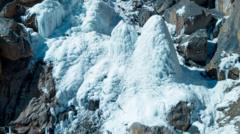
In the stark, high-altitude desert of Ladakh, where villagers once battled vanishing glaciers and extreme climates to grow essential crops, a remarkable technological innovation is now transforming lives. Known as the Automated Ice Reservoir (AIR) system, these "artificial ice pyramids" are providing a reliable water source precisely when mountain farmers need it most, ensuring harvests and stemming a tide of rural migration.
For generations, communities like Sakti, nestled at nearly 4,000 meters (13,000 feet) above sea level, have relied on meltwater from low-altitude glaciers. However, global warming has dramatically altered this delicate balance. "Ladakh has a brutal, single-cultivation season," explains Gelak Gutme, a 65-year-old farmer from Sakti, who has spent his life cultivating wheat, peas, and potatoes. "It is a desert with an extreme climate."
A Disappearing Lifeline: The Impact of Climate Change
Gutme's experience reflects a widespread crisis. The smaller, lower-altitude glaciers that once acted as natural, frozen water towers, slowly releasing their stores as spring farming began, have now largely vanished. Lobzang Fardod, a member of a local water management committee in Ladakh, articulates the grim reality: "Now that those lower glaciers have completely vanished into a desert of dry rock, there is nothing left at the top to melt."
This disappearance has left farmers vulnerable. The mountain summer is fleeting, demanding that crops be planted by May to ensure they mature before the harsh winter returns. Without early spring water, fields dry out, and livelihoods are lost. "Now there is scarcity of water. Last year I lost everything - my entire field got dried due of lack of water," Gutme laments, a sentiment echoed across the region.
Early Innovations and Their Challenges
Recognizing the urgent need, some Ladakh villages embarked on innovative solutions in the early 2010s. They attempted to create their own ice reservoirs, known as "ice stupas." This method involved piping water from higher mountain elevations during winter and spraying it into the frigid air, allowing it to freeze and gradually form large, conical ice towers. These stupas successfully supplied meltwater in the spring, offering a ray of hope.
However, the ice stupas presented significant management challenges. Fardod describes them as a "nightmare" to operate under severe winter conditions. Temperatures in Ladakh often plunge below minus 20 degrees Celsius, sometimes even reaching minus 30 degrees Celsius. Such extreme cold meant the water in the pipes was prone to freezing, leading to cracks and the complete failure of the system. To prevent this, teams of four or five farmers would undertake arduous stints, camping high in the mountains near water sources, ready to rush with boiling water to thaw any blockages, often in the dead of night when temperatures were lowest.
Murtaza Ali, executive engineer in the Irrigation and Flood Control Division at the Ladakh Autonomous Hill Development Council, also pointed out the inefficiency of the earlier ice stupa system. Because water flowed continuously, warmer days would cause newly formed ice to melt, reducing the net accumulation. Leh, the capital of Ladakh, a disputed region in Indian-administered Kashmir, has become a hotbed for what Ali calls "innovative, grassroots hydraulic engineering" as traditional water systems increasingly fail.
The Rise of the Automated Ice Reservoir (AIR) System
Over the last couple of years, this quest for water security has led to a significant technological breakthrough. In collaboration with the private company Acres of Ice, a sophisticated new system has emerged: the Automated Ice Reservoir (AIR). This "tech upgrade" precisely controls ice production, eliminating the previous pitfalls and vastly improving efficiency.
Dr. Suryanarayanan Balasubramanian, the founder of Acres of Ice, explains the core mechanism: water is still piped down from higher elevations, arriving at the valley floor under natural pressure. It then shoots out of a vertical nozzle, forming what he describes as a "massive fountain." The critical difference, however, lies in its automation.
The entire flow is managed by a computer-controlled system housed within a weatherproof box, powered by solar panels and a battery. This control system is intricately linked to a local weather station, constantly monitoring environmental conditions, including the crucial water temperature inside the pipe. This network is the brain behind the operation.
If sensors detect that the air temperature is dropping too rapidly, or if the water temperature within the pipe approaches a dangerous freezing threshold, the system takes immediate protective action. It automatically shuts off the valve at the top of the stream and simultaneously opens a valve at the bottom, completely draining any standing water out of the pipe. This ingenious mechanism entirely sidesteps the ruinous problem of cracked pipes that plagued earlier efforts.
Precision Engineering for Maximum Ice Production
Beyond pipe protection, the AIR system is also far more efficient at creating ice. Instead of a continuous spray, AIR operates by firing precise bursts of mist. Each burst coats the existing ice layer, and then the system pauses. "The system waits precisely long enough for that layer of water droplets to freeze solid based on current wind and humidity, then fires the spray again," Balasubramanian details. This meticulous, intermittent spraying ensures that almost all of the diverted water is converted into solid ice, minimizing waste and maximizing accumulation.
The entire operation runs autonomously, connected by a local wireless network that links the control box to its various valves. Crucially, the villagers also retain a manual override option, ensuring they have control if unforeseen circumstances arise.
Reviving Villages, Restoring Hope
The impact of these automated ice pyramids on village life is already palpable. Murtaza Ali reports encouraging feedback from local communities: "When we speak to the villagers, they are saying the groundwater is getting recharged and spring sources are getting revived. They are getting water in time." The local authorities and Acres of Ice are now planning a scientific study to quantify the precise environmental and agricultural benefits.
During the winter of 2025, Acres of Ice, in partnership with the local government, successfully implemented 10 AIR projects across Ladakh. This expanding network of artificial glaciers is not just providing water; it's rejuvenating entire ecosystems and economies.
For farmer Gelak Gutme in Sakti, the single AIR system has brought a newfound sense of security. His optimism for the future is evident. He hopes his village will soon build at least two more of these vital artificial glaciers. "I am a farmer, land is all that I have to survive on. I don't know the technology, all that I know today is that I have water to grow my crops," he expresses with heartfelt simplicity.
The implications extend beyond agriculture. The lack of water had previously driven many young people from these mountain villages to seek work in distant cities. Gutme notes, "We live in harsh climate that makes our life difficulty and lack of water was creating more issues. Many of youths in the village wanted to go to cities to work. That would have been a disaster." By stabilizing local agriculture, the AIR system helps anchor communities and preserve their traditional way of life, preventing a demographic crisis.
The Bigger Picture: Scaling Sustainable Solutions
The success of the AIR system in Ladakh highlights the immense potential of grassroots innovation married with advanced technology to combat the effects of climate change in vulnerable regions. Dr. Balasubramanian and Acres of Ice are now focused on scaling up this promising solution. "Our biggest challenge right now is to push the envelope in the technology to see how we can multiply the number of ice reservoirs we are building. With the same system that previously used to build only one ice reservoir, can we build a dozen?" he ponders, outlining an ambitious vision for the future.
These artificial ice pyramids represent more than just ingenious engineering; they are symbols of resilience and adaptation in the face of a changing climate. As global temperatures continue to rise, the lessons learned and the technologies developed in places like Ladakh offer vital insights for communities worldwide struggling with similar environmental pressures.
Decode Today News delivers breaking news on AI, tech, business, politics, and world events — updated daily.
breaking news, AI news, technology news, India news, world news, business news #decodetodaynews