India's 'Blue Gold' Starts a Global Drinks Revolution, Fueled by Tech and Ambition
India's 'Blue Gold' Starts a Global Drinks Revolution, Fueled by Tech and Ambition
By Decode Today News
In a remarkable transformation unfolding across India's Deccan Plateau, a plant once considered a "stubborn, valueless weed" is now sparking a new drinks industry, earning it the moniker "blue gold." The agave americana cactus, long used merely as fencing to deter wild animals, is being harvested and processed, laying the groundwork for India's entry into the burgeoning global market for agave spirits, a sector dominated by tequila and mezcal.
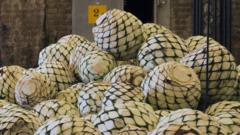
For farmers like Masapalli Venkatesh, whose 10-acre farm in Kandukur typically yields tomatoes, peanuts, and corn, the agave's newfound value represents a significant shift. Back in 2010, Venkatesh was approached by traders seeking this unconventional crop. What began as an unexpected opportunity has blossomed into a vital source of supplementary income for him and his community.
From Roadside Weed to Economic Opportunity
Unlike Mexico, where vast, organized plantations of blue agave define the tequila-producing landscape of Jalisco, India's agave industry is taking a different path. Here, entrepreneurs and farmers are primarily collecting and processing wild-growing agave. This approach has turned what was once an overlooked botanical into a valuable commodity, providing welcome additional earnings for many, including Venkatesh, who now coordinates villagers and farmers across a 100km radius.
"By combining the yields of multiple farms, I ensure a steady, high-volume supply that distilleries are willing to pay a premium for," Venkatesh explains, highlighting the collaborative effort required to meet the nascent industry's demands. This localized, aggregated model is a defining characteristic of India's early agave development.
The process of harvesting agave is a highly specialized skill. The most crucial component is the plant's heart, known as the piña, which visually resembles a giant pineapple. Experienced workers meticulously chop away the spiky leaves to reveal this core. However, precision in timing is paramount. Once an agave plant decides to bloom, its entire reserve of accumulated sugar rapidly channels upwards into the stalk. Should the flower open, the sugar content is completely depleted, rendering the piña useless for alcohol production.
Rakshay Dhariwal, founder of the distillery Maya Pistola Agavepura, emphasizes this critical window. "Gatherers must accurately identify the exact pre-blooming window to harvest the plant at its absolute peak sugar capacity, making the timing of the harvest incredibly narrow," he states. This delicate balance of nature and timing underscores the expertise required at the very start of the supply chain.
The Race Against Time: From Field to Distillery
Once harvested, the race against the clock begins. The piñas must reach a pressure cooker within 24 hours to ensure efficient sugar extraction. Any delay can compromise the entire batch, as Dhariwal warns. "If it takes longer than 24 hours, the internal sugars begin to rot and ferment unpredictably, destroying the delicate flavour profile needed for premium spirits."
This tight deadline is further complicated by India's dispersed agave supply. Agave sources are scattered across vast distances in states like Karnataka, Maharashtra, Rajasthan, and Andhra Pradesh. Brands cannot simply place orders with a single, centralized cooperative. Instead, they rely on intricate networks of local aggregators who scout, negotiate, and harvest individual patches of semi-wild agave found on marginal lands or rural property boundaries.
Despite these logistical challenges, the demand for agave spirits in India is surging. According to Dhariwal, the Indian market is experiencing a remarkable 31% growth rate. Vikram Achanta, co-founder of 30 Best Bars India, notes that "India's finally caught the tequila bug" in recent years. He observes a growing consumer base far more open to exploring new spirits than before, though agave drinks are unlikely to supplant whisky, India's perennial favorite.
Achanta sees the emergence of new brands as exciting examples of early experimentation. He highlights their innovative use of wild agave from the Deccan Plateau, which is actively shaping a distinctive Indian agave identity. While still in its nascent stages, this movement is elevating the category from mere curiosity to one of increasing credibility.
Pioneering the Path with Scientific Vision
A pivotal figure in this nascent industry is Desmond Nazareth, founder of Agave India. His company launched India's first homegrown agave spirit in 2011, a venture that began with "kitchen experiments" and evolved into India's first craft agave distillery after nearly 12 years of dedicated research and experimentation. Nazareth reflects, "We were making Indian agave spirit long before the market was ready for it. It was a craft business way ahead of its time."
Nazareth is now employing a scientific approach to cultivate and expand the industry. His team utilizes satellite images of areas where agave thrives, then matches those environmental patterns with nearby regions to identify additional suitable land for cultivation. This forward-thinking strategy is crucial, given that agave plants take 9 to 13 years to mature. "If you plant in the wrong area, you lose a decade," he cautions.
With rising demand, a natural concern arises about the potential depletion of India's wild agave supplies. However, agricultural expert Miguel Braganza offers reassurance, suggesting that this is not a concern for at least five years, and likely longer. He points out that India's domestic industry remains tiny, currently boasting only one processing plant for agave hearts, belonging to Nazareth's Agave India.
Furthermore, wild agave is remarkably adept at self-propagation. Braganza explains the plant's clever reproductive strategy: "When you look at a wild agave, you aren't just looking at a single plant. Beneath the soil, the mother agave is incredibly busy. Throughout her 10-to-20-year life, she secretly sends out long root-runners into the earth." These roots are the genesis of future plants. "Every few feet, a mini-clone of herself pops out. Those baby plants grow their own roots and become independent plants, slowly forming large agave colonies over time. So one plant can naturally turn into dozens of plants across an area without any human help," he adds.
Bridging the Gap: India's Vision Meets Global Standards
While India's abundant wild agave supply offers a cost advantage, it also presents unique challenges. Indian entrepreneur Sree Harsha Vadlamudi highlights the genetic inconsistency of wild plants. "That means sugar yields fluctuate... and that means alcohol output changes. So standardizing production becomes difficult. Mexico solved this over decades through selective breeding. India hasn't yet," says Vadlamudi, co-founder of tequila brand Loca Loka.
Loca Loka, for instance, sources its blue agave from Mexico's Jalisco heartland, specifically leveraging the rich, iron-heavy red soil from ancient volcanic eruptions. Vadlamudi explains, "This unique terroir imparts a distinct flavour profile to the agave that cannot be replicated by growing the same seeds in Indian soil." This choice underscores the current gap in consistent quality and terroir-specific profiles.
Mexico's large, organized agave farms stand in stark contrast to India's informal system. These established farms possess the resources for high-tech farming techniques, including the integration of drones and AI systems for crop monitoring. Vadlamudi details their advanced capabilities: "Drones scan thousands of hectares to accurately count individual crops, assess plant health, spot early signs of disease, and monitor the growth of the piña to predict the absolute perfect window for harvesting."
Such significant investment in agricultural technology is still a distant prospect for most Indian producers. However, Desmond Nazareth remains undeterred. He acknowledges that building a robust agave spirit industry will demand time and persistent effort but expresses strong confidence in India's potential. "India could absolutely become a major agave economy. The Deccan Plateau alone has millions of acres suitable for cultivation. We could theoretically rival Mexico if there's long-term vision and patience."
The Bigger Picture: India's Agave Aspirations
The journey of India's 'blue gold' from an overlooked weed to the foundation of a new drinks industry is a compelling narrative of innovation, entrepreneurship, and agricultural transformation. What began with local farmers like Masapalli Venkatesh discovering new value in a native plant is now evolving into a structured industry, propelled by pioneers like Desmond Nazareth and informed by a scientific approach to cultivation.
While challenges remain in standardizing production and integrating advanced agricultural technologies on the scale seen in Mexico, India's vast cultivable land and a growing consumer appetite position it as a formidable contender in the global agave spirits market. The blend of traditional harvesting, strategic aggregation, and a future vision embracing technology, from satellite mapping to potential drone integration, suggests that India's agave story is only just beginning, promising a unique identity for spirits born from its own "blue gold."


