Decode Today News delivers breaking news on AI, tech, business, politics, and world events — updated daily.
breaking news, AI news, technology news, India news, world news, business news #decodetodaynews
AI will create more jobs for humans, not replace them, Amazon founder Bezos says
By Decode Today News
AI will create more jobs for humans, not replace them, Amazon founder Bezos says Tech
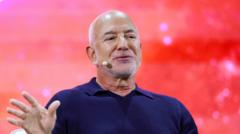
Amazon founder Jeff Bezos has delivered a robust counter-argument to widespread fears surrounding artificial intelligence, predicting that the burgeoning technology will ultimately lead to a surge in demand for human workers rather than making them redundant. Speaking at the VivaTech conference in Paris, Europe's largest tech expo, Bezos asserted his strong disagreement with the notion that AI will displace large segments of the workforce, instead forecasting a future where AI unlocks new opportunities and even creates a "labour shortage."
Bezos's optimistic outlook stands in contrast to concerns voiced by other prominent figures in technology and politics. For instance, former UK Prime Minister Rishi Sunak, who now advises Microsoft and AI firm Anthropic, recently indicated that AI was already impacting job prospects for young people. However, Bezos firmly dismissed such anxieties, stating, "I know there's a lot of concern that many people have, including many smart people, that AI is going to make humans redundant and so on. I totally disagree with this point of view. And I think, in fact, AI is going to create a labour shortage."
His vision paints an expansive picture of AI's societal role, suggesting that human limitations often stem not from a lack of ambition, but from barriers that advanced technology can effectively dismantle. This perspective underlines a core belief that AI will serve as an enabler, expanding human capabilities and opening up previously unforeseen avenues for employment and innovation.
Bezos himself is actively involved in this transformative shift through his new AI venture, Prometheus. This initiative is specifically focused on accelerating physical manufacturing, a sector that is increasingly embracing automation. The integration of AI into complex industrial processes, according to Bezos, will not just optimize existing operations but also necessitate new types of human oversight, creativity, and problem-solving, thereby generating novel job categories.
The discussion around AI's impact on employment is a global one, with organizations like the UK's Trades Union Congress (TUC) also weighing in. The TUC has warned that AI technology could risk repeating "the disaster of deindustrialisation," where shareholders accrue wealth while jobs are "degraded or displaced." However, the TUC's stance is not entirely pessimistic, acknowledging that AI possesses "transformative potential if developed properly," and could lead to significant productivity gains from which workers could ultimately benefit. This nuanced view highlights the ongoing debate and the importance of responsible development in the AI space.
Beyond AI: Bezos's Vision for Space and Blue Origin's Journey
Beyond the immediate implications of artificial intelligence on terrestrial jobs, Bezos also used his platform at VivaTech Paris to articulate his long-term vision for space exploration. He characterized space as "supply constrained, not demand constrained," emphasizing that the primary obstacle to humanity's future development and expansion remains access to space. For Bezos, the Moon represents a natural and strategic starting point for human expansion beyond Earth, owing to its relative proximity and rich potential resources.
"We're going to the Moon to stay, not just to visit," Bezos declared to the audience. He elaborated on how future technologies, such as electrolysis, could eventually enable the utilization of lunar resources to refuel rockets and sustain a permanent human presence beyond Earth. This ambitious goal underscores the competitive and rapidly advancing field of commercial spaceflight, where long-term sustainability and resource independence are critical for deep-space endeavors.
The conversation naturally extended to another of Bezos's significant ventures, his space travel company, Blue Origin. The company recently faced a setback when an uncrewed New Glenn rocket exploded during a ground test at Cape Canaveral in Florida in May. Bezos addressed the incident candidly, describing it as "a gut punch for the whole team." Yet, he revealed a silver lining: "what we've learned since then is we got really lucky." No injuries were reported, and crucial pieces of launch infrastructure, including propellant and fuel systems that would have taken considerably longer to replace, remarkably survived the incident.
Providing further updates, Blue Origin chief executive Dave Limp, who shared the stage with Bezos, confirmed that reconstruction work at the launch site is already underway. Limp expressed confidence that the company expects launches to resume before the end of the year. Blue Origin is a key contender in the burgeoning market for commercial spaceflight and lunar exploration, engaging in a high-stakes race with rivals like Elon Musk's SpaceX to establish itself as a dominant player in developing extraterrestrial infrastructure.
The Physical World of AI: Robots and Brain-Computer Interfaces at VivaTech
Away from the main stage, the broader trends showcased at VivaTech Paris reinforced the idea of AI moving beyond software applications and into the physical realm. One of the most captivating exhibits was Unitree's humanoid robot, which drew constant queues of visitors eager to witness the latest advancements in robotics. This particular demonstration highlighted the robot's collaboration with HABS, a French neuro-AI company. HABS showcased technology designed to enable humans to interact with machines using cognitive signals rather than traditional speech commands.
The demonstration was a glimpse into a future where human-machine interaction is more intuitive and seamless. The robot responded to commands generated through brain activity, facilitated by a headband equipped with an electroencephalogram (EEG) – a device using small metal probes (electrodes) that touch the scalp to measure brain waves. This innovative test offered a compelling vision of how humans and machines could collaborate in sophisticated ways, potentially revolutionizing industries from healthcare to manufacturing and hospitality.
The rise of humanoid robots, capable of working alongside humans, is increasingly becoming a reality. Companies globally are investing heavily in developing these machines, recognizing their potential to augment human labor and take on tasks that are repetitive, dangerous, or require precision in various sectors. This shift signifies a broader trend where AI is no longer confined to digital interfaces but is actively reshaping the tangible world, creating intelligent agents that can perceive, reason, and act within our environments.
The Bigger Picture
The discussions at VivaTech, particularly Bezos's assertive stance on AI and job creation, underscore a critical juncture in the global technological landscape. The narrative is shifting from a simplistic fear of job displacement to a more nuanced understanding of AI's potential to catalyze new industries, demand new skills, and fundamentally redefine human work. As AI continues its rapid evolution, particularly its integration into physical applications like manufacturing and robotics, the emphasis will increasingly be on human-AI collaboration.
The ambitious pursuits in space exploration, exemplified by Blue Origin's endeavors, further illustrate humanity's drive to overcome current limitations and expand its reach. The intersection of advanced AI, robotics, and aerospace technologies suggests a future where productivity gains on Earth are matched by unprecedented opportunities off-world. These interconnected advancements promise not only to create new jobs and economic opportunities but also to push the boundaries of what is possible, shaping a future where human ingenuity, augmented by technology, tackles grand challenges both on our planet and beyond. The ongoing evolution of AI and related technologies promises to reshape global economies, cultures, and the very nature of human progress for decades to come.
Decode Today News delivers breaking news on AI, tech, business, politics, and world events — updated daily.
breaking news, AI news, technology news, India news, world news, business news #decodetodaynews